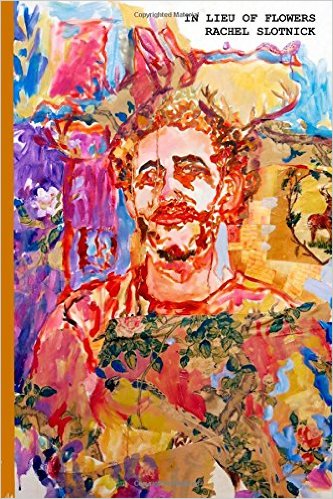
 Rachel Slotnick’s In Lieu of Flowers is a series of epistle like poems that address ideas of memory, time, and the nuances that pervade both concepts. Woven between the poems and poetic prose are poignant illustrations, collages, and graffiti that capture perfectly the essence, the sadness, and the pragmatism with which Slotnick takes on the world in her collection.
Each section of the book is addressed to a different person: Fisherman, Mathematician, and Musician. Further, each address is a calling not only to the named person, but to a specific idea attached to that person. In Dear Fisherman, Slotnick particularly addresses the subject of her father: a man in love with the sea, a man handicapped by a shark, a man with a wooden stump for an arm. After his experiences in youth, her father “became a shark hunter, and he hated all trees for daring to resemble him.” As shown in this example, Slotnick has a knack for capturing language at its most vulnerable and apt entry points and twisting it to fit the exact mood and mode of her poetry.
She uses this section to explore ideas of life, and passing through life, as it slowly slips through your fingers like water. “At the edges of the fishbowl,” Slotnick describes the last moments she spends with her father, moments in a hospital, moments in which she can see his life slipping away as well as the life the two have yet to live together. Each slipping further, he towards death, and she towards a life without her father. “I realized we both knew we were headed somewhere strange,” Slotnick remarks as she watches her father leaving her.
As in the early section, Dear Mathematician also addresses the concept of death and the passage of time. This address, though, is made to Slotnick’s grandfather, a man so in love, that without his wife, his life, became a living landmark of her memory. “Memory is a strange father,” says Slotnick. “It’s funny how you tend to remember sweetly,” trying your best to ignore the harshness of life, the pain in memory. At its end, Dear Mathematician also confronts death with the passing of Slotnick’s grandfather, and though sad in its content and in its form, Slotnick somehow portrays the reality of death with a sincerity rather than an edge toward the depressive.
The book ends with Dear Musician, which could almost be a calling to the author herself as an artist in love and in hate with her art.
Throughout all three sections, Slotnick draws through the theme of flowers. Flowers that grow in nature, funereal flowers, and flowers for the beginnings of something like love. Each series of poems in itself could be seen as in lieu of flowers – something given to the people addressed besides flowers – something potentially more, or something equally as, meaningful and significant as flowers.
A beautifully and artfully composed collection of both poetry and unique images, In Lieu of Flowers is Slotnick’s first book of poetry and is a masterpiece of a first book.
Published by Tortoise Books, you can purchase In Lieu of Flowers on Amazon.
Read more poetry book reviews at Centered on Books.
FTC Disclaimer: This book was given to me in return for a fair and honest review of the text.
 A story about the battle of fate versus volition, about western versus eastern medicine, and most importantly about the expected versus desired roles of a woman, Fill the Sky by Katherine A. Sherbrooke is an exploratory novel that is both moving and riveting.
 Shakespeare never gets old, but when someone makes him new again (and in the most engaging, hilarious, and Shakespearean way), it is somehow exhilarating. That is exactly what Anne Tyler does with her latest novel Vinegar Girl. Rewriting The Taming of the Shrew in a contemporary context, Tyler takes what is one of Shakespeare’s most sexists plays and turns it into a dialogue about feminism and equality.
 Jana Prikryl’s first published collection of poetry, The After Party, is a border-blurring, portrait-painting, investigation of humanity.
 Yasmine El Rashidi’s first novel, Chronicle of a Last Summer, tells a story of power, loss, and survival in Egypt during times of deep political unrest. The main character, an unnamed narrator, speaks to the reader from three different summers of her life: 1984, 1998, and 2014.
 Black lives do matter because black lives are human lives. All humans are simply that: human. No matter the color of their skin, their sexual preference, or the amount of money they make in a year, we are all human. In Between the World and Me, Ta-Nehisi Coates says just this and so much more in a 152-page letter to his fifteen-year-old son.
 Shakespeare is arguably one of the greatest literary figures of all time. In saying this, who could ever retell his stories with, at the very least, an equal caliber? Jeanette Winterson does just this in her latest novel The Gap of Time.
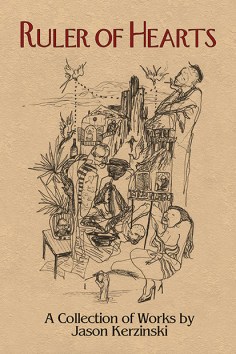 Ruler of Hearts by Jason Kerzinski is a poetically driven collection of works that glimpses the lives of those in the French Quarter of New Orleans with a searing depth.
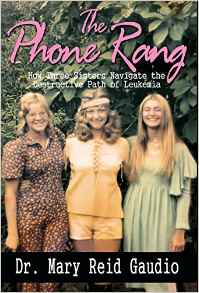 The Phone Rang by Mary Reid Gaudio is the story of three sisters as they stand together to fight the battle against their sister Ann’s Leukemia. Autobiographical, historical and full of moral insight, The Phone Rang touches on multiple aspects of both the sisters’ lives and Leukemia as a destructive disease.
 A modern retelling of William Shakespeare’s The Merchant of Venice finds the perfect balance of traditional and contemporary in Howard Jacobson’s Shylock Is My Name.
 Centered on Books