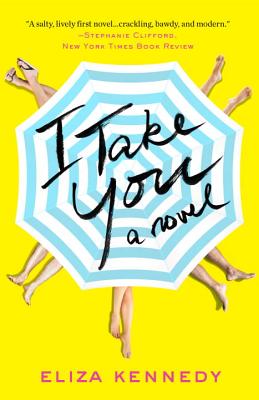
‘I Take You’ by Eliza Kennedy

i-take-you-kennedyWhat does it mean to be an adult? What does it take to be a parent, a husband, a wife? Where is the line between being flawed and being a bad person? Above all of the questions, though, hovers the central tension in author Eliza Kennedy’s debut novel I Take You: what is the value of marriage and monogamy?

I Take You is a novel about a woman in her twenties, Lily Wilder, who is about to marry Will, a man she has known for six months and who proposed to Lily after only weeks of knowing her. Not only that, but Lily is a pathological liar, cheater, drug abuser, and borderline alcoholic – none of which her fiancé Will knows about.

Throughout I Take You, Lily is at constant war with herself as to whether she should marry Will or not. Should she quit her gallivanting and devote herself to a single man? Is that what she wants? Is she even capable of being faithful?

Surrounded by a hoard of divorced mothers and a libertine father, Lily has a hard time discerning what is right and wrong in the world of love and marriage. How much can you ever know a person before marrying them anyway? How can you ever truly know it’s the “right” person or that the relationship will last forever? What if that person is the right person for that moment in time, but you change and evolve in different ways that make you incompatible later?

While these are valid questions to raise, they become slightly less valuable in the face of Will and Lily’s rather overzealous engagement: there’s no way they can know each other by the point of their marriage. Nonetheless, they are important questions to be asked, because in the end, what does it mean to be in love? How does love then become qualified for marriage? Is a strong feeling the same as love; is it just passion, or something else entirely?

In Lily’s particular case, she is chronically unfaithful to her fiancé, and the reader wonders what this has to say about Lily. She is fully aware of her actions, of the pain she’s sure her actions will cause, and yet she doesn’t change. Is she incapable of change? Does she simply choose not to change, and does this selfishness make her a bad person?

The book spirals into wild developments that change the entire nature of the arguments presented and delve into deeper, harder, and more terrifying questions about love, marriage, and monogamy. Kennedy does a great job of tying up her ends without a total “happily ever after” or doomsday ending.

I Take You, is a book about so many different things, but when it comes down to it, it’s really about being human, about experiencing the human condition of loving and being loved, and about both living in the present moment and being aware that a future exists where your present actions will have an impact.

Published by Broadway Books in 016, I Take You is available for purchase at your local bookstore.

Read more fiction book reviews at Centered on Books.

FTC Disclaimer: This book was given to me in return for a fair and honest review of the text.
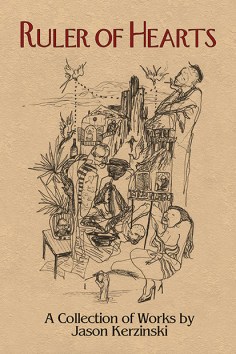
 

‘Ruler of Hearts’ by Jason Kerzinski

ruler of hearts-kerzinskiRuler of Hearts by Jason Kerzinski is a poetically driven collection of works that glimpses the lives of those in the French Quarter of New Orleans with a searing depth.

Kerzinski divides his collection into four different sections: Ruler of Hearts, Little Abyss, In Bloom, and Exceedingly Beautiful. Each section features a host of mini character sketches focusing on a different aspect of life for those characters. From the effect that New Orleans has on in its people, to ideas of both spiritual and physical death, Ruler of Hearts captures the most intimate moments of life in mere pages.

The long form poems range from one paragraph to a few pages, but the poignancy with which Kerzinski is able to grasp and dissect the lives of his characters is what propels the collection forward. Each piece focuses on a different person who the reader has never met before, and yet by the end of that piece the reader feels as if she knows this character in an intimate way, as if she’s been reading about him for 150 pages already.

Rather than flowery language, Kerzinski utilizes short terse descriptions to feed the narratives, and he does so in the most compelling way. Though he might be simply telling the reader exactly what’s happening, the images that he procures are visceral and moving in a way that transports the reader directly to the scene. Kerzinski also includes illustrations throughout Ruler of Hearts: black and white sketches that symbolize some aspect of a particular poem or section.  The illustrations are uniquely oblique, and some of them are utterly terrifying; yet, all of them throw you into the piece with greater fervor, wonder, and dread.

Ruler of Hearts is a beautifully crafted work that gets at the heart of life in the French Quarter in the most direct and concise manner. Kerzinski is a master of descriptive poetics, and his first published collection is a testament to this claim.

Published by Obzene Press in 2016, Ruler of Hearts is available for purchase online at Obzene Press.

Read more book reviews of small press published work at Centered on Books.

FTC Disclaimer: This book was given to me in return for a fair and honest review of the text.

‘Shylock Is My Name’ by Howard Jacobson

shylock-is-my-name-jacobsonA modern retelling of William Shakespeare’s The Merchant of Venice finds the perfect balance of traditional and contemporary in Howard Jacobson’s Shylock Is My Name.

Jacobson’s novel follows Simon Strulovich, a character in the image of Shakespeare’s Shylock himself: a man who feels he is on the verge of losing everything, including his daughter, his respect, and his wealth. Mirrored by Shylock, a fellow man of Jewish descent that Strulovich meets in a cemetery, the two characters stroll through the pages of Jacobson’s novel sometimes almost as a single unit, sometimes as the perfect antagonist to one another.

After Strulovich and Shylock meet in the cemetery, they proceed to spend the rest of the novel mostly discussing the very similar situations in which they find themselves. Both feel abandoned by daughters who have chosen Christian men as lovers, both have wives who are not fully present, both feel the weight of anti-Semitism that surrounds them, and both struggle to fit themselves into a world they understand as specifically anti-Jewish when they themselves don’t always align with Jewish heritage, culture or religion.

The irony, facetiousness, and comedy bound up in many of the very serious topics at hand, imbues Jacobson’s novel with an air of Shakespearean wit. While exploring themes of materialism, collective culture, the irony of malice and revenge, as well as the importance of relationships both familial and plutonic, Jacobson is able to move with a grace and ease that make the topics, though heavy, somehow more digestible. The prose itself is near poetic, and any Shakespeare fan will not only be thrilled by meeting numerous Shakespearean characters, but also by the many borrowed lines and plot points as well.

Despite all of the Shakespearean references, allusions, and outright proclamations, Shylock Is My Name is a book that could be enjoyable to any population. The themes explored, the power of the prose, and the depth of the characters make for a deeply moving, hilarious, and frustration inducing novel.

Published by Hogarth Press in 2016, Shylock Is My Name is available for purchase at your local bookstore.

Read more fiction book reviews at Centered on Books.

FTC Disclaimer: This book was given to me in return for a fair and honest review of the text.

‘Surreptitiously Yours’ by Kristen Fouquet

OLYMPUS DIGITAL CAMERA

OLYMPUS DIGITAL CAMERA

Where are the bounds of privacy, and what does it mean to respect privacy in the face of art making? A young film student asks just this question in Kristen Fouquet’s novella Surreptitiously Yours.  In a book where noir meets literary, meets poetry, Surreptitiously Yours also delves into deeper themes of truth, love and the limits of art.

Claudette’s thesis for her film degree revolves around the idea of surreptitiously filming people in public so that they are in their most authentic state of being. Her argument is that her subjects are a greater representation of truth because they don’t know that they are being filmed and are thereby not moved to act, speak, or behave in any one certain way. Claudette’s thesis, already controversial in itself, spirals to encompass a whirlwind of murder, subjugation, and the absolute perversion of privacy. But is it all in the name of truth?

At what point does the very validity of truth come into question because of the means by which it was obtained? In tandem, at what point does truth become subverted and manipulated by the person filming because of his or her own biases, beliefs, or desires? Claudette is forced to ask herself these questions about her own work once she becomes the victim of a classmate’s perverse film project herself based on a twisted version of her own idea.

Fouquet does an amazing job of keeping her readers on the edge of their seats as she winds through scene after scene of action while also developing her characters into rich, believable people in just under 125 pages. Every time the reader thinks she knows what is coming next, Fouquet flips the story on its head and sends it reeling in another direction.

A book so artfully composed and beautifully constructed, Surreptitiously Yours is as vivid as any film could ever hope to be.

Surreptitiously Yours was published in March of 2016 by Le Salon Press and can be purchased from Fouquet’s website. Watch the trailer for Surreptitiously Yours if you want to catch a glimpse of what is in store for you as a reader.

Read more fiction book reviews at Centered on Books.

FTC Disclaimer: This book was given to me in return for a fair and honest review of the text.

‘The Little Paris Bookshop’ by Nina George

the-little-paris-bookshop-georgeThe Little Paris Bookshop by Nina George is an enchanting tale of love, loss and living through them both. Much more than just a sappy love story though, The Little Paris Bookshop looks into the very soul beneath human action and into the internal passions that drive us all.
Set in Paris and in the south of France, The Little Paris Bookshop follows the story of Monsieur Perdu, a just past middle aged bookshop owner who is still pining for his unrequited love twenty one years after the dissolution of their relationship. M. Perdu spends his days prescribing books to people from his Literary Apothecary which is housed aboard a boat named Lulu, and his nights alone and mourning the absence of his lover.

Perdu’s self-contained world, though, is shattered when a new tenant moves into 27 Rue Montagnard and finds the unopened letter that Perdu’s lover wrote to him twenty one years ago when she left. Finally, moved to open the letter Perdu embarks on a journey to unravel the mysteries concerning both his lover and himself.

Along the way, Perdu encounters many characters who do for him what he has done for countless others with his Literary Apothecary: they prescribe to him just the right action for leaving sorrow, embracing grief, finding joy and releasing himself. From tango dancing to eating succulent foods, Perdu slowly begins to loosen the hold he has on himself, his past, and his willingness to love again.

A magically charged tale of enchanting depth and beautiful coincidence (or fate), The Little Paris Bookshop delves into themes that touch every human being. George explores what it means to live fully, to love fully, and to be fully human all while telling a story that will make readers tear up at the turn of every other page. A brilliant, funny, terrifying, and inspiring novel, The Little Paris Bookshop is an absolute must read.

Published by Broadway Books in 2016 and translated from the original German into English, you can purchase The Little Paris Bookshop at your local bookstore today.

Read more fiction book reviews at Centered on Books.

FTC Disclaimer: This book was given to me in return for a fair and honest review of the text.

‘The Valley’ by John Renehan

the-valley-renehanWar is a terrible and terrifying experience no matter the situation, but take crime, drugs, manipulation and scandal and you have a whole new world of terrible and terrifying. That is the exact picture of the war in Afghanistan that John Renehan paints in his novel The Valley. Renehan, a former field officer in Iraq, writes The Valley from an intimate vantage point, though he is clear in stating that he has never visited the places he mentions in the novel and that he depended more on research than on personal experience when it came to the setting.
Though Renehan jumps a bit between characters, the main protagonist in The Valley is Lieutenant Black, a desk officer who is assigned a 15-6, or an investigation. This particular investigation involves a troop that is stationed in the Valley, a mysterious and notoriously dangerous place between the border of Afghanistan and Pakistan. Black arrives to investigate a stray bullet that was shot in the village by one of the soldiers stationed there. Immediately upon arrival though, things seem a bit out of sorts, and Black slowly begins to unravel the pieces of a well-weaved story.

In a way, Renehan writes The Valley as a mystery novel, dropping clues for the reader to try to figure out the mystery for herself. The mystery, though, is so convoluted and twisted up in other mysteries that it is at times hard to follow who is manipulating who, who is lying, who is the good guy and the bad. But really, these are the lessons of war, the uncertainty bound up in fighting violently with other cultures, with one another, and with ourselves. Renehan is sure to wrap everything up in the end, and in the final pages, the reader is able to sigh a breath of relief: everything makes sense.

Beautifully written, Renehan weaves not only literal poetry into his work, but his writing style in itself is poetic. The mysterious aura of the Valley and of particular characters in The Valley makes the novel an almost ethereal and majestic read at times.

The Valley is Renehan’s first novel, and was nominated for Indie Next List in 2015. The Valley was published in 2015 by Dutton, a Penguin Group publisher.

Read more fiction book reviews at Centered on Books.

FTC Disclaimer: This book was given to me in return for a fair and honest review of the text.

‘The Vegetarian’ by Han Kang

the-vegetarian-han-kangWhat is the difference between living and enduring? What is life when it is controlled by someone external to yourself? What is reality and how do we know that the place our physical being resides in is it? Among many other esoteric questions, Han Kang tackles these in her novel The Vegetarian. Addressing issues of abuse and the effects of trauma on the human psyche, Kang provides a unique glimpse into the convergence between sanity and insanity.

At the beginning of the novel, Yeong-hye has just become a vegetarian. Living in a very patriarchal Korea, Yeong-hye is berated by her husband for not eating meat herself or cooking it for him. The most interesting aspect of the first section of Kang’s novel is the fact that it is not told from Yeong-hye’s perspective, but from her abusive and oblivious husband Cheong. The reader feels even more intensely for Yeong-hye’s plight in hearing the misogynistic remarks that come from Cheong’s mouth. The skewed lens through which he views his wife as an object only serves to fuel the rampant anger we build for Yeong-hye.

The next section is told from the perspective of Yeong-hye’s brother-in-law, a washed up artist who when we first meet him is imbued with the passion to pursue a new artistic project: that of painting his sister-in-law in flowers and filming erotic visions of her. The reader is once again privy to the working of the patriarchal mind. In viewing the objectification of both Yeong-hye and her sister In-hye, the horror only continues.

Throughout the course of the novel Yeong-hye struggles with anorexia and eventually appears to be losing her sanity. The men around her can’t fathom why she is going to such great lengths to reclaim her body and herself: it is only her sister who can relate in some distant sense to the horrors that Yeong-hye has experienced. The final portion of the novel is told from In-hye’s perspective, and in accessing the female mind, we are also granted better access to Yeong-hye herself. In seeing herself in Yeong-hye, In-hye begins to question the very fabric of reality and the lines between lucidity and insanity.

The Vegetarian is a tragic and beautiful tale of the terror that abuse brings, and the lengths to which the abused will go to assert their power

The Vegetarian was original published in 2007, but was recently translated to English and published by Hogarth Press in 2015. You can purchase a copy of The Vegetarian at your local bookstore.

Read more fiction book reviews at Centered on Books.

FTC Disclaimer: This book was given to me in return for a fair and honest review of the text.

‘Lost Birds’ by Birute Putrius

lost-birds-putriusLost Birds by Birute Putrius is very much a story of loss, change and the ability to adapt to both. Following a slew of displaced persons from Lithuania, Lost Birds tells the tale of what it means to feel an outsider in your home, your country and your overall life.

Putrius, a displaced person (DP) herself, relays the story from multiple perspectives so that the reader can see what it means to be a DP from all angles. Each chapter is told from a different viewpoint, and Putrius follows each of her characters from childhood into middle age. With this timelines, the reader grows up with the characters beginning from the moment they set foot in America.

Although at first the novel focuses primarily on what it means to leave your homeland and feel a foreigner in a new unknown place, the book quickly takes on even more issues that are pertinent not only to DPs, but to the human condition itself. Themes of acceptance, unrequited love, mental illness and spirituality all play a lead role at one point or another in the novel. Characters find and lose themselves as the years pass, and in the end, Putrius seems to be telling us that perhaps there’s no other way to live than to lose and find yourself over and over again.

Each character is interesting and engaging in her own way; however, the multiple changes in perspective and point of view can sometimes give the novel a bit of a disjointed feel, as if each chapter is its own short story, complete in itself. This aspect doesn’t detract from the overall emotionality of the novel or its arc, but it does call itself out often enough to distract the reader now and again.

Despite the intermittent disconnect between chapters, Lost Birds is a thrilling book that discusses issues not only relevant to displaced people of any kind, but to the condition of being human.

Published by Birchwood Press in December of 2015, Lost Birds is available at your local bookstore.

Read more fiction book reviews at Centered on Books.

FTC Disclaimer: This book was given to me in return for a fair and honest review of the text.

‘2 A.M. at the Cat’s Pajamas’ by Marie-Helene Bertino

2am-at-the-cats-pajamas-bertino2 A.M. at The Cat’s Pajamas by Marie-Helene Bertino is the tragi-comedy of 2015. With pages full of characters that not only pull on the core of your heart, but annoy and baffle you to no end, Bertino does an excellent job of capturing what it is to be human: imperfect, beautiful, ugly and loved.
The cast of characters that make their appearance in 2 A.M. at The Cat’s Pajamas ranges from nine-year-old Madeline, a motherless vagabond with an abusive father, to her teacher the love-lust Sarina, to the gruff owner of the night club The Cat’s Pajamas, Lorca, who is about to lose his club because of violated city ordinances. These are only a few of the featured characters into whose heads we are allowed access, among others are Pedro the dog, Madeline’s father, Madeline’s pseudo caretaker, and Madeline’s principle.

At first, Bertino’s head hopping is a bit jarring, and makes 2 A.M. at The Cat’s Pajamas hard to fully delve into. It takes a bit of time to become acclimated to not only Bertino’s style of jumping from character to character, but also to the characters themselves; since, in all the jumping, readers aren’t able to get to know the characters as well so quickly. However, once you settle into Bertino’s style, the novel careens off at high-speed, and each section is a drum roll for a new character that you can’t wait to hear about. You begin to fall in love with Sarina and Madeline, with Lorca and his son, while chastising them for their impatience or ignorance or lack of action, while at the same time realizing these are many of the actions that we all tend toward for a majority of our lives, especially when it concerns anything important.

Bertino captures the human essence in this way. She shows it in the way that everyone is a little bit self-doubting no matter how talented or hard working they are, in the way that we can’t help but love the people we love even if they treat us poorly and especially if we are children, in the way that love is unexpected and shows up just when you need it most but when you are expecting it least, in the way that we often treat the ones we love with harshness out of love, out of protection. Bertino reminds us that no one is perfect but that we can all be loved and love ourselves if we just let go a little bit. Even the most terrible characters in the novel you can’t help but love by the end and find empathy for them in their plights.

A sort of backwards fairytale that doesn’t necessarily have a happy ending, but ends more happily than it begins, 2 A.M. at The Cat’s Pajamas is beautiful and hilarious examination of the human condition placed in a ridiculously believable setting that makes it all the more real and magical at the same time.

Published by Broadway Books and released in 2015, 2 A.M. At the Cat’s Pajama’s is available for purchase at your local bookstore.

Read more fiction book reviews at Centered on Books.

FTC Disclaimer: This book was given to me in return for a fair and honest review of the text.

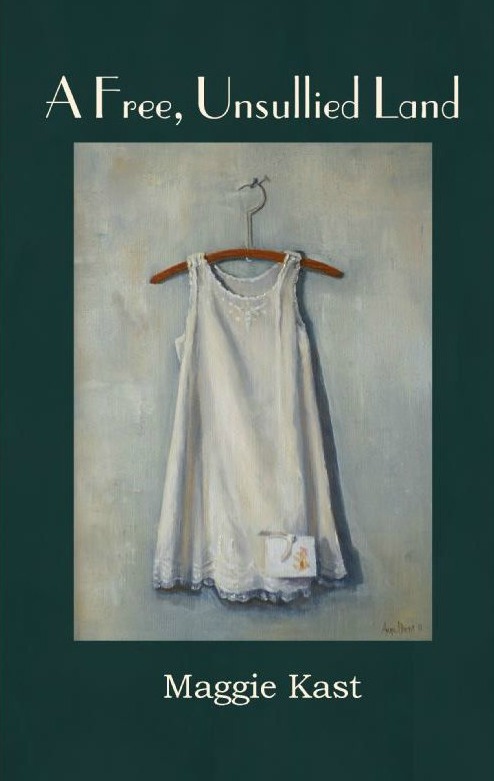
A Free, Unsullied Land by Maggie Kast

A-Free-Unsullied-LandIn a A Free, Unsullied Land, Maggie Kast tells Henriette Greenberg’s coming of age tale as she grows up in prohibition era Chicago. Henriette is a troubled nineteen year old girl when the reader meets her, and as a sheltered teenager, she is wooed by stories of the greater world that she has yet to experience. She has just enrolled at The University of Chicago and is about to set out on an adventure to live her own life and to separate herself from the dysfunctional household from which she comes.

Henriette though, like most teenagers, is plagued by a myriad of thoughts, issues and desires that often throw her off her course or make it challenging for her to actually find her course. Her interests range from psychoanalysis to anthropology, from communism to civil rights. However, her emotional and relational sense of self is shadowed by a secret of her past that mars her relationships, especially with men, propelling them into states of utter dysfunction.

The reader learns within the first hundred pages that Henriette has an unresolved sexual experience that she does not fully remember, nor does she fully understand how to process it even years later. Though the reveal seems to come rather late in the novel, it is easy to pick up on the clues Henriette leaves prior to the reveal, and the reader knows from the outset that she has a troubled past in relation to sexuality.

Henriette can often seem like a self-entitled, privileged moaner, and this at first makes it hard to always sympathize with or understand her in regards to her motives. However, as the novel progresses and we not only learn more about Henriette, but she learns more about herself, it becomes apparent that Henriette is simply a teenager. As she grows, she becomes less spastic and more rational, less demanding and more understanding of the world around her and the other people in it.

What Kast does a phenomenal job of is showing Henriette’s transformation from a sheltered and privileged seventeen year old girl to a young adult living on her own and dealing with her own problems not only with the outside world, but with herself. The arc of Henriette’s development from a damaged self into a stronger, more assertive and resilient woman makes her, in the end, a relatable and noteworthy character. The troubles that she goes through and the deluded way in which she often handles her problems in her youth are not only recognized, but remedied in that recognition. Henriette sees her own foolishness and is simultaneously able to understand and accept herself and her past in a way that she can’t at the outset of the novel.

A tale of growing up, of dealing with pain and of learning to love the self that other’s can’t always see, A Free, Unsullied Land  also drips with relevant historical underpinnings and shows readers a glimpse of what life must have been like in the 1920s and 30s.

A Free, Unsullied Land was released by Fomite Press on November 1, 2015. Don’t miss the launch of the novel at Women and Children First on Friday, November 13.

Read more fiction book reviews at Centered on Books.

FTC Disclaimer: This book was given to me in return for a fair and honest review of the text.