
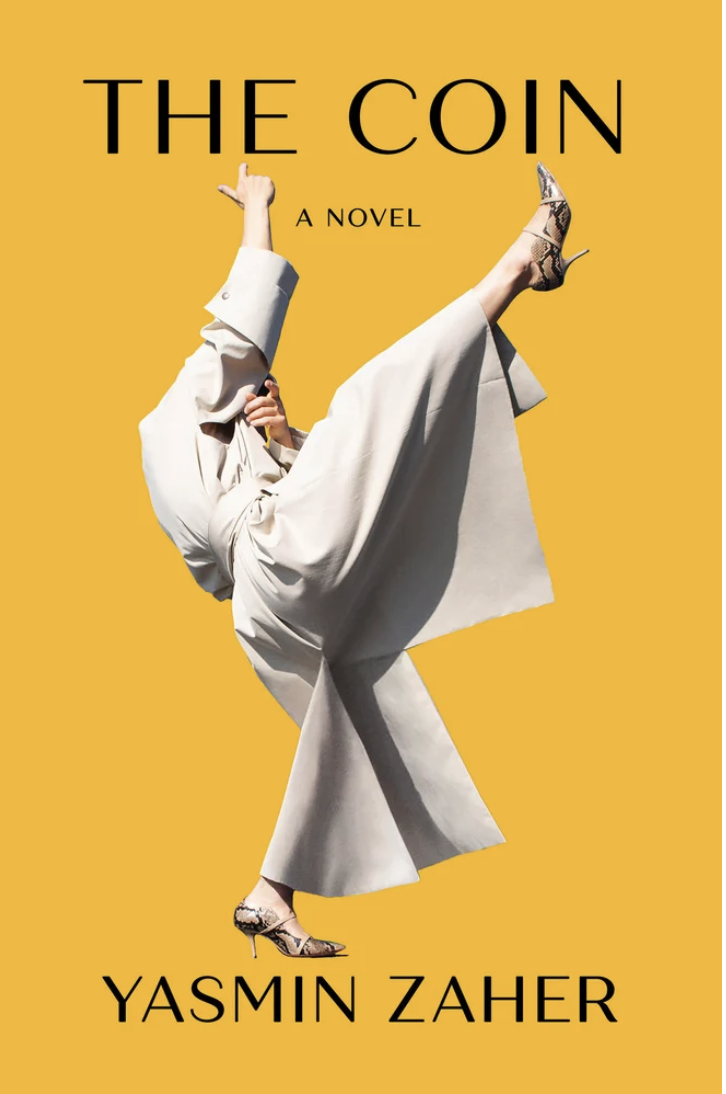
The Coin by Yasmin Zaher is a gritty and beautiful novel about identity, control, and the contradictions inherent in all of humanity. The narrator is an unnamed Palestinian woman trying to survive the grime of New York City while teaching at an all-boys prep school. From the outset, we learn that our narrator is haunted both by dirt and by a coin she swallowed as a child during a car ride that would ultimately result in her parents’ death.
Amidst her daily struggles as a teacher to manipulate her students into seeing the world from her point of view, she keeps her home and her body pristine through intensive cleansing rituals. She soaks in her bathtub endlessly and uses French toothpaste and a “Turkish hammam loofah” to scrub her body raw. But it’s all to little avail. There is a small spot on her back she simply cannot reach: the spot where the coin from her youth is lodged.
During an interview for Vogue, Zaher said, “As I continued writing, I understood that cleanliness is a metaphor for morality and also for control. We can’t control the world and its chaos, but we can control our home and bodies, so we build illusions of control by keeping things clean and organized.” In The Coin, the narrator tells us, the women of her family also used cleanliness as a way to control the uncontrollable in their homeland of violence and displacement.
Much of the novel is consumed by these attempts at control through the extensively detailed cleaning routines mentioned above, evoking an almost American Psycho-esque feel of cataloging. A millionaire with limited access to her own inheritance due to her father’s will and her brother’s control of said inheritance (hello, patriarchy), she lives on little, but lavish little that she keeps entirely pristine, of course. She dresses strictly in Gucci, Alexander McQueen, and other top designers. Despite her high fashion standards, she can’t help but judge both her own obsession with beauty and fashion while simultaneously condemning the capitalist restraints of American culture. She jukes this capitalism system and its control of her and the people around her by leaving a Burberry coat on a trash can for a homeless man to find, encouraging her students to steal from her, and even engaging in a convoluted scheme to resell Birkin bags on the black market.
Between these almost fever-dream moments where we see the narrator at work on cleaning herself, engaging in the Birkin pyramid scheme, or attempting to influence her students, we catch memories of the coin, of her parents, of her brother and grandmother, all of which lead the reader home to Palestine. Through these memories, we learn about the Jewish occupation of Palestine and the hard truths of what this occupation means for Palestinians in their own homeland—an utter lack of control. She tells the story of a Jewish neighbor from her youth, an aspiring ballerina who lived in a house that had previously been the home of a (now) forcefully displaced Palestinian family, of how the Jewish family, while doing construction on the old house, found a chest of gold through a hidden door off the basement bathroom and celebrated its finding as if the gold was theirs.
With elegant, flawless (often funny) writing and a wonderfully unreliable narrator making wonderfully terrible choices, Zaher’s work conjures the essence of fellow writers such as Ottessa Moshfeg and Anna Dorn, in addition to the above mentioned Bret Easton Ellis. Besides how fun and absurd the novel often is, one of the loveliest things about The Coin is how the contradictions are never solved, the narrator is never made wholly clean, and the coin is never retrieved. We’re left in the end, uncertain exactly where we’ve ended up, but certain that the bizarre journey was worth the while.
Published by Catapult in 2024, you can pick up a copy of The Coin by Yasmin Zaher at your local independent bookstore or bookshop.org today.
 A story about the battle of fate versus volition, about western versus eastern medicine, and most importantly about the expected versus desired roles of a woman, Fill the Sky by Katherine A. Sherbrooke is an exploratory novel that is both moving and riveting.
 In an alternate vein of reality, at the dawn of World War 2, lives Esther bat Josephus, the daughter of the Khazar kagnate’s kender (the leading policy advisor). Esther has seen firsthand, the terror that the Germanii enemy has the potential to rain to on her people, and while her father and country seem to sit idle, Esther feels that she alone must take action in Emily Barton’s latest novel The Book of Esther.
 Why is it that the greatest suffering always involves someone or something that we love? Perhaps because the loss of, the imperfection of, the mere existence of pleasure invites pain. In The Pleasure You Suffer, authors inquire into this phenomenon of pleasure’s linkage to pain through short stories and poetry.
 An evocative and exhilarating read, Jessica Cluess’ first novel in her Kingdom on Fire series, A Shadow Bright and Burning is nearly impossible to put down. A young adult fantasy novel that addresses coming of age themes, feminist mentality, and issues inherent in discrimination and exclusion, A Shadow Bright and Burning is a book full of riveting content both on the surface of its plot and in the deeper realms of its layered meanings.
 A book so compelling you could read it in a single sitting, One Half from the East tells a story much larger than the characters involved. Nadia Hashimi’s second novel follows Obayda, a ten-year-old bacha posh, or a girl dressed as a boy, living in Afghanistan. Obayda’s family turns her into Obayd to bring the family honor and with the magical hope that in doing so, their next child will be a boy.
 Every mystery needs to be solved. That’s what Jack Nash told his daughter Hazel when she was a child, and that’s what sticks in Hazel’s head after she wakes up in a hospital with nearly no memory of her former life. Through Hazel, Jack and other characters, Brad Meltzer and Todd Goldberg take readers on a wild ride through a myriad of conspiracies and mysteries in their latest novel The House of Secrets.
 What does it mean to live fully? What does it mean to be crazy? Where do freewill, imagination, and the idea of taking chances come into play with each of these questions? Tania Unsworth probes into these inquires in her latest young adult fiction novel Brightwood.
 The Nocturnals: The Ominous Eye is the second in Tracey Hecht’s The Nocturnals middle grade series illustrated by Kate Liebman. The book follows three nocturnal friends: Dawn the fox, Bismark the sugar glider, and Tobin the pangolin, as they attempt to save their forest home from a threatening, yet seen beast.
 Shakespeare never gets old, but when someone makes him new again (and in the most engaging, hilarious, and Shakespearean way), it is somehow exhilarating. That is exactly what Anne Tyler does with her latest novel Vinegar Girl. Rewriting The Taming of the Shrew in a contemporary context, Tyler takes what is one of Shakespeare’s most sexists plays and turns it into a dialogue about feminism and equality.
 Centered on Books