Author Interview with Tammy Flanders Hetrick

Author Tammy Flanders Hetrick

Jessica Anderson Photography

In this interview with Tammy Flanders Hetrick, author of ‘Stella Rose’, issues of craft, friendship, parenthood and female strength are discussed.

Q: At first glance, Stella Rose appears to simply be a heartbreaking novel about death and loss, yet you are able to take a topic that is by no means light and imbue it with hope, purpose and a sense of inspiration. What prompted the actual plotline to develop as it did? Why this story?

A: Years ago, a dear friend of mine was battling leukemia – and she survived. During that time, I found a bruise on my arm. Bruising is sometimes a symptom of leukemia, and I thought to myself, what if? My son was already out of the house, but my daughter, Ariel, was entering her last year of high school. If something happened to me, my husband could take care of her, but I really wanted my best friend to be involved. She and Ariel always had a special bond. I often joked that between the two of us, we made the perfect mom for Ariel. The story arc formed in my mind in an instant – though the writing took several years.

Q: In a similar vein, messages of perseverance, courage and optimism pervade Stella Rose, despite the hardship and abuse that is abundant across its pages. Did you start out with these themes or with the characters, storyline, etc.?

A: I started with the characters and the story arc. Then I poured out the first messy draft during NANOWRIMO (National Novel Writing Month). That’s when the plotlines formed and various themes emerged. I describe myself as an intentional, devoted optimist, so it was inevitable that no matter how dark I would go with this story, my characters would find courage and perseverance – though usually the hard way.  So during the revisions, I mined these characters for traits that would see them through, even if they weren’t obvious or elegant.

Q: Friendship is an important theme in the book: even Stella Rose and Olivia at times appear to be friends even though they are mother and daughter. Can you talk more about what friendship means for you both in the context of the novel and in the world at large?

A: Friendship is foundational. As women, we have many relationships to manage: spouse, mother, daughter, employee, etc.  We love these people in our lives, but let’s face it, these relationships require energy. Friends? Endless energy source! I spend an hour with a dear friend, and I am recharged. I can return to these other relationships refreshed – stronger, better. So why do we deprioritize time with our friends? Why do we take care of everyone else, then squeeze our friends into tiny slots of time – if at all? Because we think friends are indulgences instead of the life’s blood they really are. Friendships make us better, and then we make better families and better communities. This is what I wanted to convey in Stella Rose, and it’s what I want to talk to women about every day.

Q: The book focuses specifically on women and their journeys through love, loss, joy and hardship. Can you speak to the importance of the strong feminine presence in the novel?

A: I have been blessed with strong women in my life who have expected no less than a strong presence from me, so it’s who I am. I couldn’t write a novel without a strong feminine presence, but even I could, I wouldn’t. We don’t have strong women in print, though I am heartened by YA series like the Hunger Games and Divergent. Additionally, I wanted to show strength in more ways than physical prowess. My characters’ strength comes in the form of fierce compassion, loyalty, and integrity, as well as how much they can endure and still show up for each other.

Q: The challenge of writing a character that doesn’t quite make a physical appearance in the book must have been vast. Did you always know you wanted to make Stella most palpable through her letters, or did that develop later?

A: As I was barreling through the story, I realized with a start that Stella was barely mentioned after the first sketchy chapter. I pondered ways to weave Stella into the story and then thought, what would I do? If I knew I was dying, would I just trust everything to turn out right? I had already written one letter by Stella thanking Abby for taking care of Olivia. Then it struck me: 12 letters and mementos which would say more about Stella than flashbacks and other devices. These letters became the glue that helped me hold the novel together when it became unwieldy. Then they became the glue that held the characters together.

Q: What is your greatest hope for Stella Rose? What, if anything, do you most hope readers take with them from their experience of reading?

A: My greatest hope is that Stella Rose finds its way to everyone who would be moved by its message of hope, love, and appreciation. I hope every reader takes away a renewed sense of devotion to their friends and family. Maybe it’s time to pick up the phone – or even better, pick up the pen!

Tammy Flanders Hetrick has been telling stories all her life, refining her skills at age ten through marathon tag-team storytelling with her best friend, honing her craft through decades of business writing, and ultimately finding joy in extracurricular creative writing. She has published short stories in Your Teen Magazine, Blue Ocean Institute’s Sea Stories, and Route 7 Literary Journal. In 2009 she was recognized with the Outdoor Industries Women’s Coalition’s Pioneering Woman Award for coaching and mentoring women in the workplace. Hetrick lives in Vermont with her husband of thirty years, their two cats, and a beagle/miniature bull mix. Her website is http://www.tammyflandershetrick.com/.

Ruby by Cynthia Bond

Ruby by Cynthia BondRuby by Cynthia Bond is a novel of love, liberty, and the maintaining of dignity in the face of hardship, exploitation and layers of distrust.

The story takes place in Liberty, Texas, a town blanketed in despair and shrouded in an evil that is perpetuated and reinvigorated with each new generation.  At the beginning of the novel, Ruby Bell has returned from New York where she went in search of the mother who abandoned her as a child. She has come back to Liberty to find the same dank, horror-filled must that she left behind; only now the tenebrous spirit of Liberty has ensnared her with new vigor.

Though the residents of Liberty reject Ruby and think of here as merely crazy, Ephram Jennings still remembers Ruby as the young, innocent child from his own past, and he takes it upon himself to show kindness and unconditional love to the now broken woman. In the midst of this process, Ephram undergoes his own transformation toward self-assertion, self-love and self-healing.

A novel about breaking free from bondage and finding liberty in love, each of the character’s stories are a haunting reminder of just how cruel the world can be. When we first meet Ruby and Ephram we know that something is off in the way that each of them acts and interacts within their world, but we aren’t given immediate access to the why of their situations. Why is Ruby lying naked in the forest? Why does Ephram, a middle-aged man, live with his sister Celia and call her mother? As the narrative unfolds, unimaginable horrors are revealed as well as character intersections and relationships that are entirely unforeseen.

There is a highly spiritual element to the novel both at the level of institutionalized religion as well as more nature based spirituality. Evoking Roman myths like that of Daphne and Apollo as well as spirit imbued animals, tarrens (ghost children) and the Judeo-Christian God, Bond weaves together these spiritual elements to create a world fraught with contradiction, terror, and oddly enough, inspiration.

Further, questions of sanity pervade the pages of the book. What does it mean to be sane? Who has the right to deem another person insane? To what lengths can a person be physically and emotionally driven before teetering over the edge of what is typically thought of as sane? These physical and emotional experiences are what serve to propel the novel backward and forward through time as the past horrors of Ruby, Ephram, Celia and nearly every other inhabitant of Liberty are revealed throughout the course of the novel. Ruby forces the refiguring and conceptualizing of what trauma, of what sanity and of what dignity really means.

Though at times Ruby is so graphic that it is difficult to want to turn the page and find out what happens next, Bond’s prose is so poetic and fluid that the rhythmic experience of words envelopes the reader in a mystical telling of the very real and imperfect world that we all live in.

Published by Hogarth Press in February 2015, Ruby is already a New York Times Bestseller and Oprah Book Club selection.

FTC Disclaimer: This book was given to me in return for a fair and honest review of the text.

Read more fiction book reviews at Centered on Books. 

“Stella Rose” by Tammy Flanders Hetrick

Stella Rose by Tammy Flanders HetrickStella Rose by Tammy Flanders Hetrick is a dark entanglement of reeling emotionality that throws the reader from the verge of tears to absolute hatred in the matter of mere paragraphs. Stella Rose is the mother of Olivia Weller and the best friend of narrator Abigail Solace St. Claire, and she has just died of Leukemia, leaving Olivia in the care of Abby for Olivia’s last year of high school.

Both Abby and Olivia are left to struggle not only with the death of someone they loved so much, but with the pressures of romantic love, friendship, betrayal and everything else that comes with being human. A large part of what keeps the momentum of the book going and what sets it apart from other books of a similar plot is the fact that it’s not simply a sob story about death or the loss of a loved one. Rather, Stella Rose is an exploration of living fully, not in the wake of death, but for the sake of living. There is no glossing over of difficulties, but there is also not a hanging on to the darkness that envelopes the book.

Stella is a presence in the book no doubt, but she is not an unfathomably depressing presence. Stella makes her way into the novel through the people who loved her in life and who still love her in death, as well as through the letters that she leaves for Abby and Stella. By the end of the novel, the reader has built as much empathy for Stella as for Olivia, Abby or any of the other characters in the novel in a way that makes the reader miss her all the more.

Through all of the ups and downs that Olivia and Abby experience together in their new relationship, nothing could prepare either of them, or the reader, for what Hetrick has in store for them. From insightful to terrifying and every emotion in between, Stella Rose deals with themes of abuse, privacy, passion and the power of friendship while providing strong messages on these topics for readers to take away with them. Hetrick pulls together these themes and weaves them into a story that leaves the reader feeling both stronger and more vulnerable by its completion.

There is something about Stella Rose, and it’s not the death of the eponymous character, that lifts the reader from the mundane of daily living to see the beauty in that provinciality, and that is a rare and exciting moment for any reader.

Stella Rose by Tammy Flanders Hetrick is scheduled to be released by She Writes Press on April 21, 2015. You can preorder the book at your local book store.

FTC Disclaimer:This book was given to me in return for a fair and honest review of the text.

“Twelve Thousand Mornings” by Mary Driver-Thiel

Twelve-Thousand-Mornings-Mary-Driver-ThielTwelve Thousand Mornings make up just enough days to round out about 32 years, which happens to be the amount of time that Anne Bennett has left to live, or so her dead lover tells her in a (maybe) dream.  Meant to be a sort of carpe diem, this is a much needed message for Anne since she has recently lost her husband, her fortune, and her dignity in the aftermath of a company scandal. Anne is forced to seek refuge at the home of the daughter whom she has not only neglected but almost entirely alienated from her life.

When we first meet Anne she is a nothing more than a contemptible, judgmental and entirely crude human being whose value system is scaled by fashion, weight, and beauty. Told in first person, the reader is privy to the criticisms Anne passes on everyone around her without ignominy. After seeing her sister for the first time in years, Anne can’t divert herself from thinking about how much weight her sister has gained and noticing it at times when it’s not even relevant in the context of their interaction. Nearly everything that goes on both inside of Anne’s mind and comes out of her mouth within the first 200 pages aids to accumulate in the sum of Anne’s despicability.

The most frustrating attribute that Anne possesses though is her acute awareness of her own behavior and the reasons behind why she acts the way that she does. Piece by piece Anne reveals the traumas of her past, but there are times where it feels as if the reader is being beaten over the head by Anne about her trauma. She mentions it again and again, to the point that its repetition almost detracts from its weight in the story. I often wanted to shout out: “I get it! You suffered! Stop being a horrible person!” But perhaps, such character construction is an example of author Mary Driver-Thiel is at her best.

I had to constantly question myself as to whether it was Anne, the text, or myself that I should be criticizing. I was annoyed with Anne for recognizing her issues and not acting on them. I was annoyed at Driver-Thiel for making Anne a character who recognized her issues and didn’t act on them, and I was annoyed at myself when I thought about issues in my own life that I’m aware of and don’t act on. At first I hated Anne, then I thought her self-knowledge was a character flaw, then I realized it was the self I saw in Anne that annoyed me. Driver-Thiel made Anne such a human character, such a flawed and thereby relatable human character that by the end of the book it’s hard to not love her and be happy for her despite her many detestable attributes.

Anne is a character who grows, develops and fully changes over the course of the novel, which is what the book is truly about. There is redemption, pain and reparations to be made, but really Driver-Thiel is making a statement about the life that stand before you. Whether it’s Twelve Thousand Mornings or thirty days, through Anne, Driver-Thiel begs readers to take their lives into their own hands and live as fully as possible. The idea of hope, the hope of change and the change that comes with self-asserted power culminate in an almost fairytale ending that somehow fits perfectly in the twisted, frustrating, and enraging novel.

Written as a sequel to Driver-Thiel’s first novel The World Undone, by personal experience, Twelve Thousand Mornings can easily be read as a standalone novel. However, after reading Twelve Thousand Mornings,  I am fully intrigued as to the point of view and character development that inhabits her first work.

Published by Pine Lake Press March 15, 2015, you can purchase Twelve Thousand Mornings at your local bookstore.

FTC Disclaimer: This book was given to me in return for a fair and honest review of the text.

Read more fiction book reviews at Centered on Books. 

“Black Sabbath: Symptom of the Universe” by Mick Wall

Black Sabbath biography by Mick WallBlack Sabbath: Symptom of the Universe (St. Martin’s Press) by Mick Wall is a fully comprehensive biography of not only the legendary self-same titled metal band but of each of the core band members of the group.

The 320 page book spans the entire career of the band and its diverging members up through their reunion tour in 2013. Perhaps the most interesting time periods portrayed, though, cover the lesser known years of the band’s youth before they were Black Sabbath. To learn that guitarist Tony Iommi bullied Ozzy Osbourne in primary school or that when Ozzy first joined the band he had a shaved head were interesting, odd facts that made the narrative more fully engaging, especially for a Sabbath fan who might know a good deal about the band to begin with. Though fans might be aware of the fact that Iommi lost the tips of two fingers in a factory accident, they are less likely to know that he made substitute fingers out of a melted down bottle so that he could continue to play guitar.

At first the reader is drawn into the emotional pull of the band’s inception and the excitement of their finally being recognized for their obscure and novel style of music. However, since the book covers such a large expanse of time, reading about the continual rise and fall of the band can become a bit burdensome and repetitive. This though, a fact of the band’s existence, was something that couldn’t be avoided by Wall.

Wall, a writer, editor, and press agent, writes Black Sabbath: Symptom of the Universe almost as if it were a novel. His descriptive language and storytelling style, though, does err to the side of grandiose and can be rather overbearing. There is a sense of hyperbolic animation that at times detracts from the pure sentiment that could have been conveyed in merely telling the story rather than interposing adjectival descriptions in a scene where the emotion and verve are obvious to the reader.  Wall does his best to tell the band’s history from as many viewpoints as possible, lending a level of intrigue to the text in the dissimilarities portrayed. Though he clearly shows bias in terms of which perspective he favors, he still strives to include multiple viewpoints that the reader is able to interpret on her own.

The story of Black Sabbath, of Ozzy Osbourne, of Ronnie James Dio, and of the numerous other band members who played a part in the history of both Black Sabbath’s success and demise is told in a complete and linear manner that leaves little left to be imagined.

Slated to be released by St. Martin’s Press April 14, 2015, you can preorder Black Sabbath: Symptom of the Universe by Mick Wall at your local bookstore.

FTC Disclaimer: This book was given to me by the publisher in return for a fair and honest review of the text.

Read more nonfiction book reviews at Centered on Books.

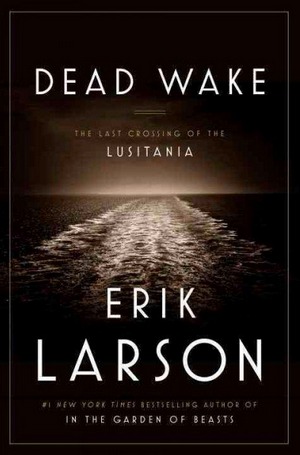
“Dead Wake: The Last Crossing of the Lusitania” by Erik Larson

Dead Wake by Erik LarsonDead Wake: The Last Crossing of the Lusitania by Erik Larson tells the story of the famed Lusitania, the passenger vessel sunk by a German submarine on May 7, 1915. Aside from the tragedy and horror of the event, the ship’s demise became solidified in history because it became one of the turning points in America’s involvement in World War I. Larson, best-selling author of Devil in the White City and In the Garden of Beasts, is known for his unique ability to retell historical events with a literary quality paralleled only by novels of fiction.

Reading Dead Wake feels like reading a history textbook that’s far more interesting and accessible than your average 600+ page academic compilation of events. A large part of this intrigue is owed to Larson’s profile of individuals whose lives were bound up in the Lusitania’s last voyage. Larson zeros in on the Lusitania’s captain William Thomas Turner, the U-20 submarine’s captain who sunk the Lusitania Walther Schwieger, as well as a number of passengers aboard the vessel. While some of the information provided can falter to the side of dry or disinteresting, for the most part Larson provides a strong platform for the reader to build empathy and connection with the “characters.”

We meet Charles Lauriat, a bookseller and collector who was travelling across the Atlantic with a rare copy of Charles Dickens’ A Christmas Carol. Other notable figures included Theodate Pope, “the first female architect licensed in Connecticut,” through who Larson shows the gross injustices done to women in the early 1900’s. Perhaps the most memorable and intimate though is the portrait Larson paints of the then United States President Woodrow Wilson. Larson not only shows the figure known to the public, but delves into the intimate life of Wilson’s pining love for Edith Galt.

Larson’s sources ranged from letters to diaries to news reports and beyond, and by far the most engaging aspect of the novel is the number of quotes that he includes. Not only are these snippets of discourse and dialogue fascinating in and of themselves, but they are also a window into the hearts and nature of their speakers.  Admiral Scheer of the German fleet was quoted as saying:

“Does it really make any difference, purely from the human point of view, whether those thousands of men who drown wear naval uniforms or belong to a merchant ship bringing food and munitions to the enemy, thus prolonging the war and augmenting the number of women and children who suffer during the war?”

Juxtaposed by this statement is that of Austrian U-boat commander Georg von Trapp who said “we [U-boat soldiers] are like highway men, sneaking up on an unsuspecting ship in such a cowardly fashion.” von Trapp envied those in the trenches and aboard ships for their closeness and intimacy with war that he felt gave them the moral advantage of actin on rage, fear and out of self-defense.

This and other statements by German, British, American and other country’s prominent naval and political figures provide insight into the general attitude of each country’s militaristic force. These quotes and notes though are not meant to act as general blanket statements for whole nations. Larson points out “that while on distant patrol the [U-boat] captain received no orders from superiors” and was thereby empowered to sink any vessel he saw fit. Because of this, Larson points out that not all U-boats and not all captains were the same: “there were cruel boats and chivalrous boats, lazy boats and energetic boats.”

Schwieger’s boat was a notably cruel boat, though as Larson points out Schwieger claimed he did not know before launching his torpedo at the Lusitania which vessel he was attacking. Larson also notes that this claim was highly unlikely. However, true to his objective telling of historical facts, Larson makes no accusations or assumptions; rather he presents the facts for the reader to decide how to interpret them. That’s not to say that Larson’s tone doesn’t sometimes betray his own feelings toward a person, nation, etc. but it does reflect the author’s intent on telling an historical accurate account.

These concrete facts extend to the survivors’ accounts of the ship’s wreck as well, as Larson explores the realities of what it means to face death and come out on the other side alive. Many passengers noted their pervasive sense of calm during the whole ordeal, and a number commented on the beauty and serenity of the sky as they floated on their backs in the 55 degree water.  These passages are what imbues Larson’s novel with the sentiment and verdure of a truly human experience that lifts the “characters” from their places on the page and makes them even more tangible and relatable and empathetic way.

Larson’s historical accuracy as well as the coupling of his statistical reporting and human profiling makes for a thoroughly engaging novel that though it may at times teeter at the edge of tedium, comes out as a strong and informative piece from which readers have much to learn.

Dead Wake: The Last Crossing of the Lusitania was released by Crown Publishing on March 10, 2015 and can be found at your local bookstore.

FTC Disclaimer: This book was given to me by the publisher in return for a fair and honest review of the text.

“The Buried Giant” by Kazuo Ishiguro

The Buried Giant by Kazuo IshiguroThe Buried Giant (Knopf )by Kazuo Ishiguro is the author’s most recent success in breaking literary boundaries while creating a story that is entirely enthralling. On the most mundane of levels The Buried Giant topples normative conceptions of genre as it spans the worlds of fantasy despite being very clearly a book of literary fiction. In a recent conversation with Erica Krouse hosted by the Lighthouse Writer’s Workshop in Denver, Colorado, Ishiguro addressed this topic by noting that a shift is underway in the literary community, and authors, especially of the younger Harry Potter generation, are becoming less and less tied to traditional conceptions of genre. Ishiguro sees this as a positive shift and noted in the interview with Krouse that he was happy to be contributing to such a movement. He openly admitted, though, that 15 years ago or less he might not have had the gall to choose the setting that he did for The Buried Giant.

The Buried Giant takes place in a post Arthurian Briton that is riddled with ogres, pixies and dragons. The novel follows the adventure of an older married couple Axl and Beatrice as they set out from their home to discover the mysteries of their forgotten past. The couple, though later in their years, is not suffering from Alzheimer’s or some other such disease; rather, there is a collective sense of forgetting that has fallen upon the whole of Briton. This fog, in sense, is what prevents nearly all of Ishiguro’s characters from keeping a hold on even near distant memories.

This shared sense of remembering, Ishiguro noted to Krouse, is at the heart of his latest exploration on the topic of memory. A good portion of Ishiguro’s books relate to memory and how memory affects a person’s understanding of her current situation and serves as the” lens for [her] relationships.” Ishiguro’s previous literary examinations of memory though have always been about the singular recollections of the narrator or main character. As a central theme to his writing, Ishiguro wanted to explore collective memory, especially as it relates to a whole nation, to love, and to the union of marriage. One of the most central themes of the book, one that Beatrice raises again and again, is the question of whether in forgetting the shared memories of two people’s pasts they can still claim to be in love.

Aside from the issues of love and memory, Ishiguro weaves through tales of battle and introduces other rather frightening characters, many of whom remain nameless. The most interesting aspect of these settings and characters is that they could essentially be left behind if Ishiguro had decided to set the book in any other place or time. If the reader were to lift out the themes, threads and issues that the book delves into, it is easy to see that the fantastical setting of The Buried Giant is secondary to the story being told beneath that surface.

This seems to make perfect sense when one considers that the most difficult aspect of writing for Ishiguro is setting, as he stated at the Lighthouse Writer’s Workshop event. He often conceives of an idea for a novel and struggles with where to place that idea in space and time. The flexibility he allows himself and the difficulty he has in coming to a conclusion is perhaps how and why Ishiguro is able to span so many genres with his writing. His previous book Never Let Me Go is a speculative literary fiction novel, while Remains of the Day is a rather romantic tragedy and a comedy of manners. Now, with a fantasy book under his belt, Ishiguro has most definitely traversed a wide range of the literary plain.

The Buried Giant, is by far one of the most engaging and fast paced of Ishiguro’s novels, and despite its 317 page girth, the book is, by experience, readable in a single day.

Purchase The Buried Giant at your local bookstore.

Read more fiction book reviews at Centered on Books.

“At The Water’s Edge” by Sara Gruen

At the Water's Edge by Sara GruenAt the Water’s Edge by bestselling author of Water For Elephants Sara Gruen is a novel of romance, adventure, and history. The book takes place in the midst of World War Two in Philadelphia and then in Scotland as a high society love triangle comprised of the narrator Maddie, her husband Ellis, and their mutual best friend Hank head on in search of the Loch Ness monster.

Ellis and Hank both have purported ailments that have kept them from enlisting in the war: Ellis is color blind and Hank is flat footed. The two men are so shamed by their inability to enlist that they decide to head to Scotland to find and film the Loch Ness monster and prove themselves heroic. Maddie is forced to come along since she has nothing in Philadelphia but a mother-in-law who wants to dissolve her son’s marriage and a father who wants nothing to do with her.

So, the three head to Scotland and check into a local inn where we meet more of the novel’s characters including Anna, Meg, and Angus. From here the story spins into tangents of monster hunting, Maddie’s slow acclamation to life outside of her china walls, and a love affair that develops only very late in the novel. Ellis and Hank, though most especially Ellis, turn out to be entirely dreadful human beings who are not only careless, but conniving, evil, and abusive. Much of the novel is spent describing the ways in which Ellis talks down to Maddie, tries to physically abuse her and emotionally berates her for what he sees as her imperfections. Frustratingly, Maddie does nothing to stand up for herself, and though this is a period piece set in a time when men did have the power to commit their wives to mental institutions, it is entirely maddening to watch Ellis dominate his wife and for Maddie to fall into patterns that reassure Ellis’ behavior.

There is definitely an air of melodrama in the book as well with Maddie constantly fainting, becoming woozy, or needing a man to save her from distress. There are few strong female characters at all in fact. Meg still pines over her boyfriend after he beats her nearly dead for wearing a pair of silk stockings that he assumes Meg slept with someone to obtain, while all of the women passively wait to be married and disappear into their respective husbands. Once again, the time period of the piece must be taken into account when trying to understand Gruen’s intention drawing such characters, but it is no less defeating for readers.

It is difficult to be surrounded by a hoard of characters for which the reader develops little sympathy because of their obnoxious behavior. The plot and all of the tangential subplots, however, are arresting and intriguing in a way that allows the reader to overlook potential frustrations in the novel’s characters. Being primarily plot driven, At the Water’s Edge will most definitely prove to be another blockbuster once a film is made.

At the Water’s Edge is slated for release from Random House Publishing on March 31, 2015. You can preorder a copy of the book here.

Read more fiction book reviews at Centered on Books.

FTC Disclaimer: This book was given to me in return for a fair and honest review of the text.

“Hausfrau” by Jill Alexander Essbaum

Hausfrau by Jill Alexander EssbaumHausfrau by Jill Alexander Essbaum at first appears to be the somewhat typical story of an unsatisfied housewife searching for meaning in her life and filling the void that has become her world with copious amounts of sex. Quite rapidly, though, the novel reveals itself as something much more discerning and intuitive.

Anna is the wife of Bruno: a woman with no driver’s license and no bank account, a self-proclaimed outcast American living in Switzerland. She has three children, one of whom she loves more than the rest, and another who holds for her the most painful part of her past.

Anna is constantly trying to convince herself of her own happiness and to make sense of her past decisions, as if granting herself pardon from her mistakes will erase them or make them easier to bear. It is obvious, though, that all of Anna’s internal warmongering, is nothing but a distraction from the fact that she cannot forgive herself or understand how and why her life has turned out the way that it has.

When we first meet Anna she has begun to see a therapist, Doktor Messerli a devout psychoanalyst, who serves no better purpose than to further reinforce Anna’s own submissive and subsumed nature. Ironically, Anna is not even truthful to her doctor, and we are compelled to stand in Anna’s lies as Messerli, often in a macabrely ironic way, tries to interpret Anna’s life with only half the details. Meanwhile, Anna goes about her life trying to divine significance, find the ability to feel, and understand her purpose in a world that has gone utterly gray.

Essbaum’s simplistic and yet deeply nuanced language lays the basis for the multitudinous layers running through the novel. Sentences are often short and terse, matter of fact and bitingly honest, while the metaphors of Hausfrau run in effulgence. Not only does the language surrounding Anna and her relationships directly correlate to those very relationships, but things as simple as the fact that Anna lives on a dead end speak volumes to the physical events in the book.

While the most potent drama of Hausfrau lies within Anna, there is an equally balanced physical component to the novel as Essbaum perfectly marries both internal and external conflict. We travel through Anna’s past, as well as her day to day life as she rides the train to her German language classes, has steamy sex with men in sheds, and confronts her husband and mother and law on a day to day basis.

Essbaum develops characters so tangible and situations so terrible it’s hard to accept that they are fiction. Even the worst of characters is so distinct and despicable that you want to know more about them. We move through the novel with Anna and feel her anguish, her pain, her annoyance with herself and we though we recognize that she is a woman utterly depressed and entirely lost we feel the sanity in all of her seemingly insane actions. A novel that at certain points will make you scream “no” and while at others it will burrow you deeper into your couch with “yes,” Hausfrau hits on every emotion in the human spectrum with a sheer brilliant aptitude.

Hausfrau by Jill Alexander Essbaum was released by Random House today and is available for purchase at your local bookstore.

Read more fiction book reviews at Centered on Books.

FTC Disclaimer: This book was given to be my NetGalley in return for a fair and honest review of the text.

“Bad Feminist” by Roxane Gay

Bad Feminist by Roxane GayBad Feminist by Roxane Gay is a collection of essays that explores topics of race, gender, politics, feminism and the ambiguities inherent in the world despite these categorizations. Perhaps most importantly, though, Bad Feminist is the amassed thoughts of one self-proclaimed “bad feminist:” an influential and conscientious woman provoking her readers to think differently about any number of uncomfortable subject matters.

Gay talks about what many people ignore, bury, or flat out deny in a way that is not only engaging but also relatable. She discusses and problematizes issues surrounding rape, what it means to be overweight, and women’s reproductive rights all while tying in examples from her personal life as well as from popular culture. Gay also addresses the preconceived notions of feminism and disputes the long standing idea that all women who are feminists are militant man haters.

Despite the fact that some of Gay’s attributes may seem to conflict with common conceptions of feminism, she still loves the color pink, dreams of love, and freely admits that she “enjoy[s] fairy tales.” This does not mean that she is ignorant to the complicated issues bound up in the traditional fairy tale model. The overly confident Prince Charming and the often complicit and inert female characters are still problematic, and Gay recognizes and addresses these issues in her own work.

Gay explains how in her novel An Untamed State, she endeavors to tell the typical fairy tale story in reverse, going from a state of happiness to a state of terror, to some sort of return. Gay has “no problem with darkness, sorrow, pain, or unhappiness,” but she strives to “complicate these themes…[to] achieve a more complete, complex understanding of happiness ” even in a story involving kidnapping, rape and the shaking of human morality.

Perhaps the most rattling of Gay’s musings revolves around sexual violence. Gay acknowledges that “we talk about rape, but” she notes “we don’t carefully talk about rape.” Rape victims are often further victimized by others besides the perpetrator, terms like “rape culture” are thrown around carelessly, and society engages in humor associated with rape and sexual violence. Gay confesses, that she is exhausted even talking about the topic. However, she “consider[s] her responsibility as a writer…to critique rape culture intelligently and illuminate the realities of sexual violence without exploiting the subject.”

In moments of raw humanity, Gay questions whether she is in fact “contributing to the cultural numbness” that allows, invites and encourages the ignorant ideologies about race, women, rape and other topics to flourish. But as Gay notes, she “would rather be a bad feminist, than no feminist at all.” Taking action is vital, but Gay suggest that accepting ambiguity and allowing for imperfections in one’s self and in one’s culture is perhaps even more vital. With Bad Feminist, Gay makes clear that nothing is clean cut, few things are unambiguous, and everything is complicated.

Read more nonfiction book reviews at Centered on Books,