‘The Coin’ by Yasmin Zaher

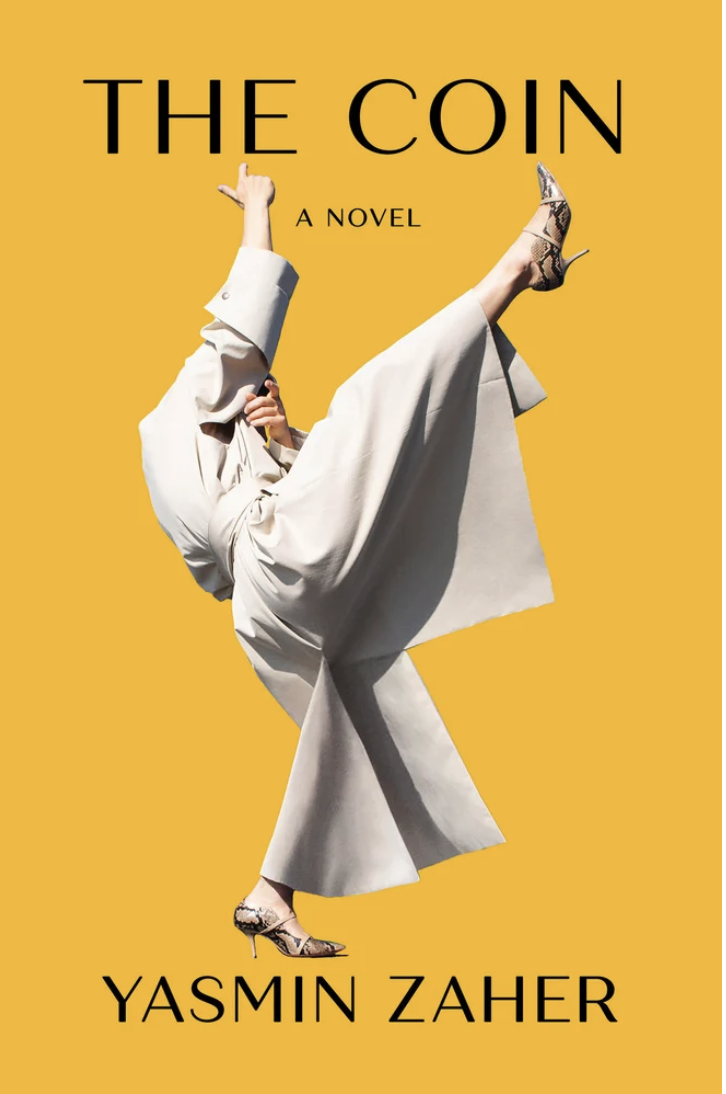
The cover of The Coin by Yasmin Zaher has a deep yellow background with a woman dressed all in white leaning back with one high-heeled foot raised in the air, her head obscured.

The Coin by Yasmin Zaher is a gritty and beautiful novel about identity, control, and the contradictions inherent in all of humanity. The narrator is an unnamed Palestinian woman trying to survive the grime of New York City while teaching at an all-boys prep school. From the outset, we learn that our narrator is haunted both by dirt and by a coin she swallowed as a child during a car ride that would ultimately result in her parents’ death.

Amidst her daily struggles as a teacher to manipulate her students into seeing the world from her point of view, she keeps her home and her body pristine through intensive cleansing rituals. She soaks in her bathtub endlessly and uses French toothpaste and a “Turkish hammam loofah” to scrub her body raw. But it’s all to little avail. There is a small spot on her back she simply cannot reach: the spot where the coin from her youth is lodged.

During an interview for Vogue, Zaher said, “As I continued writing, I understood that cleanliness is a metaphor for morality and also for control. We can’t control the world and its chaos, but we can control our home and bodies, so we build illusions of control by keeping things clean and organized.” In The Coin, the narrator tells us, the women of her family also used cleanliness as a way to control the uncontrollable in their homeland of violence and displacement. 

Much of the novel is consumed by these attempts at control through the extensively detailed cleaning routines mentioned above, evoking an almost American Psycho-esque feel of cataloging. A millionaire with limited access to her own inheritance due to her father’s will and her brother’s control of said inheritance (hello, patriarchy), she lives on little, but lavish little that she keeps entirely pristine, of course. She dresses strictly in Gucci, Alexander McQueen, and other top designers. Despite her high fashion standards, she can’t help but judge both her own obsession with beauty and fashion while simultaneously condemning the capitalist restraints of American culture. She jukes this capitalism system and its control of her and the people around her by leaving a Burberry coat on a trash can for a homeless man to find, encouraging her students to steal from her, and even engaging in a convoluted scheme to resell Birkin bags on the black market.

Between these almost fever-dream moments where we see the narrator at work on cleaning herself, engaging in the Birkin pyramid scheme, or attempting to influence her students, we catch memories of the coin, of her parents, of her brother and grandmother, all of which lead the reader home to Palestine. Through these memories, we learn about the Jewish occupation of Palestine and the hard truths of what this occupation means for Palestinians in their own homeland—an utter lack of control. She tells the story of a Jewish neighbor from her youth, an aspiring ballerina who lived in a house that had previously been the home of a (now) forcefully displaced Palestinian family, of how the Jewish family, while doing construction on the old house, found a chest of gold through a hidden door off the basement bathroom and celebrated its finding as if the gold was theirs.

With elegant, flawless (often funny) writing and a wonderfully unreliable narrator making wonderfully terrible choices, Zaher’s work conjures the essence of fellow writers such as Ottessa Moshfeg and Anna Dorn, in addition to the above mentioned Bret Easton Ellis. Besides how fun and absurd the novel often is, one of the loveliest things about The Coin is how the contradictions are never solved, the narrator is never made wholly clean, and the coin is never retrieved. We’re left in the end, uncertain exactly where we’ve ended up, but certain that the bizarre journey was worth the while.

Published by Catapult in 2024, you can pick up a copy of The Coin by Yasmin Zaher at your local independent bookstore or bookshop.org today.

Read more fiction book reviews at Centered on Books.

‘What a Wonderful World This Could Be’ by Lee Zacharias

Lee Zacharias captures something deeply universal in her new novel What a Wonderful World This Could Be: namely, what it is to be human. 

Alex is the novel’s main character: a woman confronted with questions and decisions about what it means to be a daughter, a lover, an artist, and a person. We follow Alex from her early teen years in the 1960s to her later adult life in the 1980s as she navigates personal issues of neglect, depression, and love within the larger backdrop of civil right issues and political tumult.

Weaving between periods of Alex’s life in the 1960s, 70s, and 80s, Zacharias follows Alex’s transformation from a neglected teen to a conflicted adult. All the while, readers stand beside Alex both cheering her on and cringing at her bad decisions.

While the novel can at times feel a bit disjointed, overflowing with so much plot that the reader can forget where they are and who they’re with, overall, What a Wonderful World This Could Be is an engaging and nostalgic read. Whether you grew up in the 1960s, are an artist, or have simply lived a life that involves love, loss, and heartbreak, you will find something to connect to in What a Wonderful World This Could Be.

Slated for release from Madville Publishing in June 2021, you can preorder a copy of What Wonderful World This Could Be from your local independent bookstore.

Read more fiction book reviews at Centered on Books.

FTC Disclaimer: This book was given to me in return for a fair and honest review of the text.

‘The Beauty of Their Youth’ by Joyce Hinnefeld

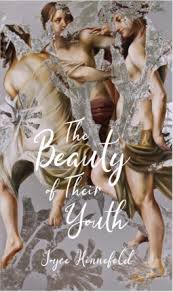
beauty-of-their-youth-hinnefeldThe Beauty of Their Youth is the latest literary work by award winning author Joyce Hinnefeld. A collection of short stories, The Beauty of Their Youth introduces five characters who struggle with making sense of their present lives through both the chartered and unchartered territories of their pasts.

From a middle-aged daughter struggling to understand her dead mother through the help of an unsuspecting neighbor, to a German woman who goes to the greatest lengths to find and preserve an authentic and different self, all of Hinnefeld’s characters are deeply tragic yet entirely relatable. No matter the age or situation of the character, Hinnefeld has a way of drawing the reader into the narrative and erasing all sense of distance or difference.

Focusing mainly on the role of the past to help understand and make sense of the present, Hinnefeld takes this idea and creates worlds in which the reader can immerse herself in that very challenge with passion and with empathy.

Beautifully told and utterly engaging, The Beauty of Their Youth by Joyce Hinnefeld is a quick but in-depth collection of stories.

The Beauty of Their Youth by Joyce Hinnefeld is slated for release by Wolfson Press in March 2020.

Read more fiction book reviews at Centered on Books.

FTC Disclaimer: This book was given to me in return for a fair and honest review of the text.

‘Relief by Execution’ by Gint Aras

relief-by-execution-arasGint Aras’ newest release, Relief by Execution, is an essay about cultural community, universal calamity, and the power of transformation.

Aras begins his long-form essay with an introduction to himself: the son of Lithuanian refugees living in a segregated neighborhood in Chicago. We learn of the unsurprising racism in Aras’ neighborhood and his family’s equally racist attitudes. We learn of Aras’ own brushes with brutality by the hands of his father, and we learn that Aras is interested in the complicated relationship between Christian and Jewish Lithuanians.’

At first the story seems jumbled, a mix of interesting and horrifying events that don’t quite piece together. That is until, Aras embarks on his own adventure to his homeland and feels at odds with visiting the concentration camps in Europe, but why? Aras admits that it’s not because he’s afraid of being emotionally affected by the atrocities committed against humanity; instead, he’s afraid of being excited by them. His family’s racist past, his own firsthand experiences with abuse, and eventually his post-traumatic stress disorder involving those experiences haunts him into believing he might be as bad as those he judges from afar.

Aras’ story is one of healing and acceptance but not of giving in, of forgiving, or of letting go. Aras’ does none of those things as he draws the story full circle from the Holocaust to his own experiences. Instead, he provides an inspiring reinterpretation of what it means to be both a victim and an abuser. The issues of nature versus nurture battle hard in Relief by Executionas Aras’ struggles with both pulls. Is it his nature to feel violent and maladaptive thoughts, or was it his upbringing that instilled these values?

A beautifully crafted and poetic essay that deals with multiple big-ticket issues in a cohesive and fluent way, Gint Aras’ Relief by Execution is a pocket-sized must-read.

Slated for release by Homebound Publications on October 9, 2019, you can preorder a copy of the book from your local bookstore today.

Read more fiction book reviews at Centered on Books.

FTC Disclaimer: This book was given to me in return for a fair and honest review of the text.

‘We Will Tell You Otherwise’ by Beth Mayer

WeWillTellYouOtherwise-MayerWe Will Tell You Otherwise is the short story collection from debut author Beth Mayer.
Already winner of the Hudson Prize from Black Lawrence Press, We Will Tell You Otherwise is an eclectic and sometimes harrowing set of stories. Mayer takes ordinary people and puts them extraordinary situations that are simply life. For example, the opening story tells the tale of a young boy’s first encounter with death: both a cadaver and a knife fight in the same night. In this story, “Don’t Tell Your Mother,” Mayer explores the coming of age narrative in a very different way.

Characters in Mayer’s collection often have a blunt or almost nonchalant way of talking about hard material. There’s the father whose son has cancer, who tells the reader plainly at the beginning of “Tell Me Something I Don’t Know,” that the cancer is “likely going to kill him eventually.” There’s the sister whose eight-year-old brother wants to be committed to an insane asylum who tells us “[t]he real problem with [her brother] is that he is eight and has yet to find his true calling.” We hear these stark, almost outlandish statements from people trying to order the chaos of their own lives into something manageable.

All of the characters are rich and unforgettable in Mayer’s collection. They all come to the page with their own unique set of problems and often leave with those same problems. And the reader is offered only a glimpse of what it all means. There’s a sense that the world is disorder, sadness, and sometimes joy. Sad characters laugh, miserable characters dream, and some of the most unfortunate of them all get away from what’s haunting them somehow.

A moving and unique set of stories, Beth Mayer’s We Will Tell You Otherwise is forthcoming from Black Lawrence Press on August 20, 2019. You can order a copy from Black Lawrence Press today.

Read more fiction book reviews at Centered on Books.

FTC Disclaimer: This book was given to me in return for a fair and honest review of the text.

‘The Island of Always’ by Stephen Evans

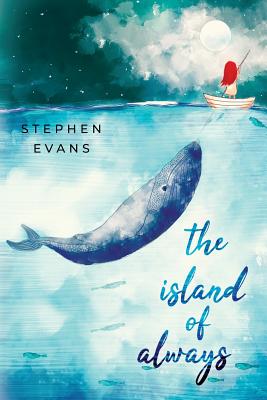
the-island-of-always-evans

Stephen Evan’s the The Island of Always is the continuation of his acclaimed novel The Marriage of True Minds originally published in 2008.

The books’ protagonists, Lena and Nick, are partners? Lovers? Enemies? Divorced? Even that’s a question. The two, it seems, are constantly trying to figure out what they are to each other. All they know is that they love each other (most of the time) and they can’t seem to live without each other, except when they are driving each other literally or metaphorically insane. Both are environmental attorneys who once owned a law practice together fighting the injustices of Minneapolis’ less enlightened. Then they got divorced, and either before or after the divorce, Nick might have developed a mental illness.

At the outset of The Marriage of True Minds (which is also included in this edition of The Island of Always), Nick is committed to a mental institution after relocating 144 lobsters to the mayor of Minneapolis’ personal pool. This kicks off a new chapter in Nick and Lena’s romantic comedy as they realize that despite their short comings, they may still love each other.

An echo to Cervantes’ Don Quixote in more than one way, The Island of Always, while comedic and lighthearted in most of its telling, does explore some deeper themes. Evan’s seems to suggest that the definition of insanity may be fluid, indefinable really, human-made definitely. Similarly, love is equally indefinable, always illusive, and never perfect, normal, or what you expected.

Evan’s brings his experience as a playwright into the novel with his descriptive and vivid sentences. The reader can always see the character: exactly what she’s doing and the emotions crossing her face. A fun and utterly enjoyable read, The Island of Always is the perfect feel-good book to boost your spirits and make you think a little differently about your life, even if only for a moment.

Slated for release by Time Being Media, LLC in January of 2019, you can preorder a copy of The Island of Always from your local bookstore.

Read more fiction book reviews at Centered on Books.

FTC Disclaimer: This book was given to me in return for a fair and honest review of the text.

‘Shelf Life of Happiness’ by Virginia Pye

shelf-life-pyeShelf Life of Happiness by Virginia Pye is a book about the expiration of happiness: the end of its shelf life.

In Pye’s collection of short stories, ordinary characters find themselves with everything they could’ve wished for, or nothing they ever wanted, and either way, the equation equals despair, longing, or defeat. While some characters may find glimmers of the happiness they seek or even the insight of a way out, we as the reader are left to wonder if they’ll pursue that happiness or not.

In “Redbone,” a painter is confronted with the meaning of love and art at the end of his life as he literally battles rough waves to stay alive. “My Mother’s Garden” explores what it means to be stuck in a cycle of life that isn’t your own.

In these and Pye’s other six stories, characters struggle to find themselves and to discern what it is that might elongate or inspire the happiness that has worn out in their lives. For most of Pye’s characters, there is at least the recognition of a next step, even if it’s not taken.

Slated for release on October 23, 2018 by Press 53, you can pre-order a copy of Shelf Life of Happiness from your local bookstore.

Read more fiction book reviews at Centered on Books.

FTC Disclaimer: This book was given to me in return for a fair and honest review of the text.

‘Home & Castle’ by Thomas Benz

Home & CAstle - BenzHome & Castle by Thomas Benz is a collection of short stories that take on questions like “why me,” “how bad can it get,” and “is this really what my life has become?” At least these were the questions that constantly bounded back and forth between the pages as Benz’s characters floundered their way through the lives that had become something other than what they had imagined for themselves.
Nobody in Home & Castle is an extraordinary person, or even a kind person for that matter. They are flawed in ways that many humans are, imperfect in ways that sometimes make you hate them or want their wives to find out their schemes. Yet, despite their imperfections, Benz has a way of drawing the reader into these flawed, sometimes twisted fantasies of the often-misogynistic characters in an attempt to unravel their minds just a little bit.

In one of the strongest stories, The Casual Imposter, we meet Blake, an average Joe who is always mistaken for another average Joe. Nearly everywhere he goes, he’s met by some stranger who thinks he’s someone else. As Blake begins to feel more and more invisible as himself, he also begins to gain a confidence, or maybe a self-consciousness, that encourages him to play along with what he feels like is a trick the world is playing on him. Blake decides to be the person he is mistake for, which he thinks might “be the key to breaking the curse.” After episodes of anxiety, nearly giving himself away, and ruining the reputation of the man he’s pretending to be with his own dreams of cheating, Blake gives the sham up only to meet the ultimate irony of all: someone he cares about can’t recognize him.

In the title story Home & Castle, we meet Drew, a middle-aged, once popular, wealthy, and well-to do man who has lost it all. Suddenly, he finds himself, the stay-at-home dad while his wife thrives along beside him. This kills Drew because he can’t stand the role reversal of our gendered society. Drew, at first a pitiful character, starts to become someone the reader herself feels embarrassed by. This embarrassment, Benz reminds us, though, is only the function of what society labels “normal” or even “acceptable.”

Benz’s writing is a lyrical wave of softness that washes over the reader, slowly, sometimes sleepily, and the stories begin to feel less read and more felt or almost experienced. Benz’s writing is refined, funny, and often sarcastic in a perfectly resonating way. By no means a speed read, Home & Castle is a beautiful collection nonetheless.

Home & Castle was published by Snake Nation Press in January of 2018. You can purchase a copy of Home & Castle by Thomas Benz at Indie Lit.

Read more reviews of books published by small presses at Centered on Books.

FTC Disclaimer: This book was given to me in return for a fair and honest review of the text.

‘This Far Isn’t Far Enough’ Lynn Sloan

this-far-isnt-far-enough-sloanThis Far Isn’t Far Enough encapsulates perfectly the feeling in every one of Lynn Sloan’s new short stories. The stories in Sloan’s collection are tragedies that nearly break your heart, or often do. Every sad ending, it seems, is the result of someone not going far enough or something not being quite enough: someone trying but not hard enough, someone succeeding, but not in the way they imagined, or someone simply being swallowed by the reality of their incapacity to evoke change in their lives.
Though the underlying theme seems to be the same across stories, Sloan does a superb job of diversifying her characters and setting each scene on a new and fresh stage. There’s the story of Ollie, the chef betrayed by his partner, friend, and lover Donnie. Ollie who is given a chance at a comeback after a scandal at his previous restaurant. But is this new chance enough? Will Donnie always haunt Ollie even in his glory — haunt him through others and through Ollie’s own memory? Is a new restaurant enough to erase the pain?

Then there’s “A Little 1,2,3;” the story of Betty, a widow confined to an assisted living home with not only the memories, but the visceral visions of her recently deceased husband beckoning her towards death. If only he hadn’t slipped while cleaning the gun. All Betty wants is to be with her husband, to escape the reality of all that she can’t remember and all that she can. But will death be enough to find happiness? Could death at the hands of the same gun that killed her husband save her from her misery?

Every one of Sloan’s characters is a monument to “what if” and “if only” and they remind readers to stop, to erase this ever-present message in humanity’s mind, because even under the guise of “if,” it could still not take you far enough. Life could still be just what it is or just what you don’t want it to be. Sloan’s characters remind us to make the effort, to live fully in what you have, and to cherish everything without the “if.”

Slated for publication by Fomite Press in February of 2018, you can reserve a copy on Amazon.

Read more nonfiction book reviews at Centered on Books.

FTC Disclaimer: This book was given to me in return for a fair and honest review of the text.

‘Ruler of Hearts’ by Jason Kerzinski

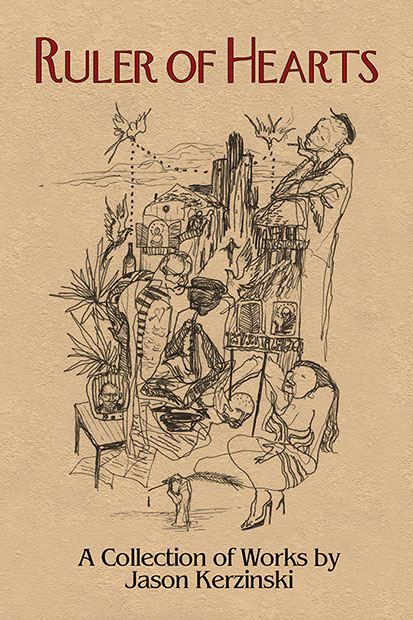
ruler of hearts-kerzinskiRuler of Hearts by Jason Kerzinski is a poetically driven collection of works that glimpses the lives of those in the French Quarter of New Orleans with a searing depth.

Kerzinski divides his collection into four different sections: Ruler of Hearts, Little Abyss, In Bloom, and Exceedingly Beautiful. Each section features a host of mini character sketches focusing on a different aspect of life for those characters. From the effect that New Orleans has on in its people, to ideas of both spiritual and physical death, Ruler of Hearts captures the most intimate moments of life in mere pages.

The long form poems range from one paragraph to a few pages, but the poignancy with which Kerzinski is able to grasp and dissect the lives of his characters is what propels the collection forward. Each piece focuses on a different person who the reader has never met before, and yet by the end of that piece the reader feels as if she knows this character in an intimate way, as if she’s been reading about him for 150 pages already.

Rather than flowery language, Kerzinski utilizes short terse descriptions to feed the narratives, and he does so in the most compelling way. Though he might be simply telling the reader exactly what’s happening, the images that he procures are visceral and moving in a way that transports the reader directly to the scene. Kerzinski also includes illustrations throughout Ruler of Hearts: black and white sketches that symbolize some aspect of a particular poem or section.  The illustrations are uniquely oblique, and some of them are utterly terrifying; yet, all of them throw you into the piece with greater fervor, wonder, and dread.

Ruler of Hearts is a beautifully crafted work that gets at the heart of life in the French Quarter in the most direct and concise manner. Kerzinski is a master of descriptive poetics, and his first published collection is a testament to this claim.

Published by Obzene Press in 2016, Ruler of Hearts is available for purchase online at Obzene Press.

Read more book reviews of small press published work at Centered on Books.

FTC Disclaimer: This book was given to me in return for a fair and honest review of the text.