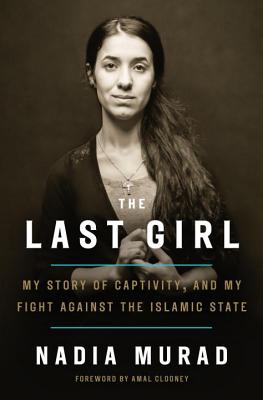
 It could’ve been me. It could’ve been you, your mother, your wife, your daughter. It could’ve been any woman living in the “wrong” time, the “wrong” place, believing the “wrong” thing. Nadia Murad’s story is the story of every woman who could have been her and wasn’t. Her story is the story of every woman in her tribe who had been her to someone else: a slave, an object, a sabayya.
Nadia grew up in a village outside of Mosul, Iraq called Kocho. Her family lived a simple life of farming, community, and prayer. But they weren’t Muslim. They were Yazidi, an almost dirty word to the leaders and followers of ISIS who were quickly taking over Iraq. And so, when ISIS decided they wanted the Yazidi gone and they needed a collection of dispensable women to keep them occupied, they began destroying the Yazidi, killing their men, kidnapping their boys, and forcing their women into slaves of sex trade.
But it was still hard for Nadia to believe anything would happen to her village, to her. Nadia was born in 1993, there hadn’t been an attack on the Yazidi in her life time. Even when ISIS came to Kocho, surrounding the borders and denying anyone entrance to and exit from the city, Nadia still had faith that everything would be okay.
And then it wasn’t. And then all of the men were dead. And Nadia was separated from her family. And she was sold. And she was raped. And she was beaten. And every ounce of dignity she had was taken from her. And she didn’t give up.
This isn’t a story about how it all ends. Nadia is the author. We know it has a “happy” ending. She lives. This is a story about what happened. This is a story about what nobody else knows is happening, what nobody is listening to, what happens when one group of people decides another isn’t worthy to be alive. This is a story about genocide and rape as a weapon of war. For Nadia, this is more than just a story, her story, this is the story she hopes will be the last. This is the story, she hopes, that will be about the last girl who was ever sold into slavery, who will ever have everything worth anything taken from her, who will have to survive to ever live again.
The Last Girl is an account of something so terrible and so recent it’s hard not to sit and think about what you were doing three years ago or less when the events of the book were taking place. It’s hard not to be enraged, deflated, encouraged, and hopeless all at the same time. The Last Girl is terrible, beautiful, and absolutely worth every moment of every person’s time. It’s a story that everyone should read, that everyone should be aware of is truth. It’s a story so powerful because it’s history and it’s the news all in one. It’s a story that should be read, that should be listened to, so that Nadia can have her dream, and so that every girl who’s experienced anything even close to Nadia’s story can one day find peace that somebody somewhere was the last girl ever stolen, the last girl ever abused, the last girl ever whose body was not their own, even for a moment.
Published by Tim Duggan Books in November of 2017, The Last Girl by Nadia Murad is available for purchase at your local bookstore.
Read more nonfiction book reviews at Centered on Books.
FTC Disclaimer: This book was given to me in return for a fair and honest review of the text.
 Dunbar by Edward St. Aubyn is the latest in Hogarth’s Shakespeare project. A modern retelling of one of Shakespeare’s greatest tragedies, King Lear, Dunbar takes on the themes of greed, family, and madness with verve and anguish.
 A novel where everything and nothing is said all at once without the slightest regard for conformity, How to Behave in a Crowd is both a hilarious and gloomy collection of pages.
 A profusion of poetic genius, The Lauras by Sara Taylor is a book that could make anyone an emotional wreck.
 Clara at the Edge by Maryl Jo Fox is the story of an older woman’s journey through the hardships she’s never been able to get over.
 Lisa McInerney’s first novel The Glorious Heresies is by far one of the best novels of the year. An epic story that spans the life of a few tormented individuals, The Glorious Heresies is a cinematic experience of firsthand addictive relationships to love, drugs, and crime.
 Skating on the Vertical by Jan English Leary gets at the most human part of life: the suffering, the challenges, the joys of living life always on the edge between joy and despair. Each of the sixteen short stories gets at something a little bit harder than the last, a little bit deeper, a little bit something more for the characters to push through. The thing that makes each story so beautiful is the humanity with which Leary brings the characters to us. There aren’t always happy endings; in fact, they’re often nowhere near happily-ever-after, but Leary always make sure to close her stories in just the right way, leaving the reader feeling completely fulfilled, if never satisfied.
 Wild Mountain by Nancy Kilgore Hayes tells the story of a small town in Vermont that, in three months time, undergoes enough change, tragedy, and novelty to spark its citizens towards entirely new realms of their lives. From floods to historic bridges being demolished and fission over marriage rights, the townspeople come to know what hardship means not only for themselves, but as a collective people.
 In the Ozarks of Missouri, a community of early 19th century settlers face the challenges of an ever-changing America in Steve Wiegenstein’s latest novel, The Language of Trees.
 To Lay to Rest Our Ghosts by Caitlin Hamilton Summie is by far one of the most emotionally riveting books of 2017.
 Centered on Books