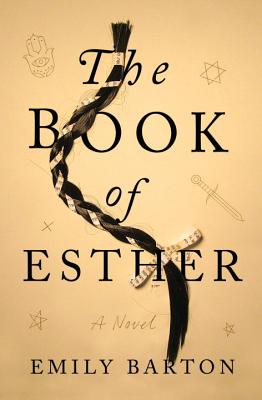
‘The Book of Esther’ by Emily Barton

the-book-of-esther-bartonIn an alternate vein of reality, at the dawn of World War 2, lives Esther bat Josephus, the daughter of the Khazar kagnate’s kender (the leading policy advisor). Esther has seen firsthand, the terror that the Germanii enemy has the potential to rain to on her people, and while her father and country seem to sit idle, Esther feels that she alone must take action in Emily Barton’s latest novel The Book of Esther.

Esther, 16, borrows her father’s mechanical horse, Seleme, some money, some candle sticks for prayers on the road, and her adopted brother and father’s slave Itakh, 9. Esther and Itakh embark on a long and arduous journey to the mystic Kabbalists in the hopes that they can turn Esther into a boy. She knows that only as a man can she lead her people into warfare and save her country.

At the very outset, author Emily Barton sets the tone for a novel of not only magical capabilities, but also of deep introspection. Esther wants to be a boy only so that she can save her country, not because she dislikes being a girl. In fact, she is set to be married in a few months, and is begrudgingly excited about it. Esther is a conflicted woman and a conflicted Jew. There are certain elements of her sex and religion that she feels hold her back from doing her greater duty to her country, and so she seeks ways around those barriers. Esther finds that though these obstructions may exist in her mind and those of her people, perhaps they are not wholly true. Perhaps Esther does not need to be a man to lead an army. Perhaps a Torah Jew need not dismiss another for not being Jewish in the same way.

Throughout the novel the theme of exclusion features prominently. Esther is excluded because she is a girl. The Khazar kagnate is being discriminated against and excluded because of the religion that they follow. Even the Khazar excludes others who are not Jewish. At first, Esther subscribes to some of these exclusionary notions to the extent that they are all she knows, but as The Book of Esther progresses, Barton probes deeper into the disadvantages of exclusion, and she fights to show that inclusion can lead to far greater success.

A book of faith, acceptance, and rebellion, Emily Barton does a superb job of blending history with fantasy and fiction in The Book of Esther. Creating a perfectly conflicted main character, Barton ensures that her readers will stand behind Esther from page one.

Released by Tim Duggan Books on June 14, 2016, you can purchase The Book of Esther at your local bookstore.

Read more fiction book reviews at Centered on Books.

FTC Disclaimer: This book was given to me in return for a fair and honest review of the text.
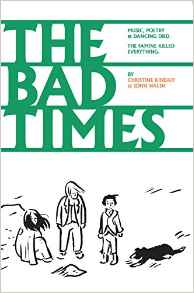


‘The Bad Times’ by Christine Kinealy and John Walsh

the-bad-times-walsh-kinealyThe Bad Times by Christine Kinealy and John Walsh is a graphic novel that tells the story of how “music, poetry and dancing died,” during The Great Famine in Ireland. Despite this statement though, through its very existence, The Bad Times stands as a testament to the resilience and revival of Irish culture after such devastation.


The story takes place in Kilkee, County Clare between the years of 1846-1849. Kinealy and Walsh follow three young friends and a dog (Brigit, Dan, Liam and Cu) from the beginning of the famine until its devastating conclusion. Brigit and Dan come from lower class farming families, while Liam’s father owns a shop and ends up profiting from the famine. Yet, despite these differences, their friendship never wavers. In fact, its very durability offers moments of clarity where the reader sees that despite starvation and death there is still a sense of humanity, of understanding and of love that supersedes greed and the need for survival.

Among other themes, Kinealy and Walsh also explore faith and the role of religion in a young person’s life when faced with adversity. The young trio is also confronted with loss, young love, the folly of pride and more throughout their three year journey together. Though the graphic novel doesn’t end quite happily, there is at the very end a grand gesture of generosity, a proclamation of love, and the hope for renewal.

When it comes to the art, Walsh does a fantastic job of fitting the style with the storyline and themes of The Bad Times. The colors are often dark and overcast, with pops of pigment that remind the reader of the possibility that lies beyond the obscurity and gloom. The stylistic choices for depicting the characters also scream “famine” with bagged eyes and a certain feeling of agedness that pervades the young characters.

As for the dialogue, Kinealy intersperses Gaelic phrases along with the colloquial Irish dialect. Though the authors never explain the exact meaning of the utterances woven in, the Gaelic doesn’t detract from the intelligibility of the piece and instead imbues it with a certain resonance, a reminder of what was lost with the death of so many.

The Bad Times is a riveting and momentous graphic novel that teaches readers about the actual historical event of The Great Famine, while also weaving in important elements pertinent to adolescence and humanity at large.

Published by Quinnupiac University Press in 2015, The Bad Times is available for purchase here.

Read more fiction book reviews at Centered on Books.

FTC Disclaimer: This book was given to me in return for a fair and honest review of the text.

‘The Invention of Wings’ by Sue Monk Kidd

The Invention of Wings by Sue Monk KiddBestselling author Sue Monk Kidd released her latest novel, The Invention of Wings, in January of last year.  A historical novel rooted in the story of Sarah and Angelina Grimke, the first female abolitionists and two of the first modern feminists, The Invention of Wings looks at issues of gender, race, and morality from a uniquely dual perspective.

The novel vacillates between being narrated by Sarah Grimke, a young southern belle, and Handful, a slave on the Grimke plantation. Both girls are subversive and oppose not only authority, but also convention, even at the young age of eleven when we first meet them. Kidd follows the girls from childhood into middle age, allowing for the reader to see and understand the situations occurring in and around their lives with a more vibrant and deep verve. There are certain stories and situations that are told both from Handful and Sarah’s point of view, while other events that are extremely important to Handful don’t even make it into Sarah’s narrative (and vice versa), because she is either unaware of them or can’t understand the impact of such events.

While both Handful and Sarah have a certain sisterly bond of love that they both acknowledge, there is a fissure between them that continues to grow as they age. Handful begins to see more and more that Sarah can never understand her position as a slave. Kidd juxtaposes the women’s rights movement with the abolition movement in so that each mirrors the other as a mode of imprisonment. However, Sarah’s issues, though vital in their own right, are often shadowed by the horrors of Handful’s life.

Sarah can at times be an overbearing and frustrating character, especially when she is placed next to Handful, whose greatest trouble can’t even come close to comparing to Sarah’s. In a certain way, The Invention of Wings, shows that everyone’s own biggest issue is as important to them as the next person’s own biggest issue no matter the gap between those issues. Sarah’s dreams and desires cannot be discounted by any means, but in comparison to Handful’s simple wishes for freedom, it’s difficult to have sympathy for the often whining, young southern princess.

Nonetheless, The Invention of Wings is full of strong female characters, Sarah included, who both take a stand against their oppressors and who offer inspiration by virtue of their will, courage, and perseverance.

Published by Penguin Books in January 2014, The Invention of Wings is available at your local bookstore.

Read more fiction book reviews at Centered on Books.

FTC Disclaimer: This book was given to me in return for a fair and honest review of the text.

All the Light We Cannot See by Anthony Doerr

All the Light We Cannot See by Anthony DoerrAll the Light We Cannot See by Anthony Doerr is a poetically charged tale of morality and love in wartime, as well as an exploration into the value of life even in the darkest of times. Told in the present-tense with a switchback narrative that guides the reader between different stages of past and present, All the Light We Cannot See mainly follows two characters, Marie-Laure and Werner, in the mid to late 1940’s.

Marie-Laure is a young blind girl living in France at the beginning of World War Two, while Werner is a perfectly Aryan German youth. Worlds apart and yet closer to one another than even the reader at first realizes, Marie-Laure and Werner spend the pages of the novel navigating their youth, their familial struggles, and their passions in life in the midst of wartime. Though we at first meet both characters later in their lives, we eventually trace them back to their childhood: Marie-Laure with her father in Paris and Werner in a mining town orphanage in Germany. However, within mere pages we follow Marie-Laure back to where we met her at her Uncle’s home in Saint-Malo and Werner to Schulpforta, a school for Nazi youth and eventually into the ranks.

Marie-Laure despite her blindness is a master of navigation and has a penchant for sea creatures and reading. Werner, not at all aligned with Hitler’s plan for the Germany or the world, sees Nazism not only as an escape from the mine that stole his father’s life but also as a gateway into engineering and science: his two greatest passions. From the outset Marie-Laure is a strong-willed character with a purity unparalleled by nearly any other character. She is constantly worrying about others, trying to do the right thing, and urging those around her into happier states of being through her optimism and persistence.

Werner, on the other hand, finds himself constantly silenced by a fear to act out of the ordinary and to be punished for doing so. While Marie-Laure was nearly born an outcast, Werner, with his hair of snow and eyes of blue struggles to remain neutral and invisible among the crowd so that he can pursue his passions even if at the expense of others. He does his best to protect those around him, such as his younger sister Jutta and his friend Fredrick; however, he does so passively, never actually standing up for either of them or acting on their behalves. Though rattled with guilt for his inaction throughout the novel, it is not until Werner has aged into his teens and experienced the more palpable horrors of war that he begins to act on his desire to do good.

Questions of value both metaphoric and literal are continually raised in the novel as Doerr prompts the reader to think about what riches really mean. The riches of gemstones, of family, and of the preciousness of life are examined by nearly every character and understood in a different way by each. Despite risking his life for a rare blue diamond, Marie-Laure’s father at one point comments that “a diamond…is only a piece of carbon compressed in the bowels of the earth for eons and driven to the surface in a volcanic pipe.” Of all the riches in the world, which is worth living for, dying for, fighting for?

Doerr suggests that perhaps it is all the light that we cannot see which, though invisible, guides us through the toughest of times to find purpose, happiness and rare moments of perfected and rich bliss. “All of light is invisible” Doerr notes, and yet it is there, always there, manifesting itself in different forms: in reflection, in colors, in our imagination, in dreams. Marie-Laure, the one character who is literally without light throughout nearly the entire novel proves to be the heroine: untouched by the darkness that has surrounded her.

A beautifully woven tale about finding light even in the darkest of places, Anthony Doerr’s New York Times Best Seller and Pulitzer Prize winning novel All the Light We Cannot See is both inspiring and moving with a momentum that keeps you reading page after page.

Published by Scribner, a division of Simon & Schuster, Inc. All the Light We Cannot See is available at your local bookstore.

Read more fiction book reviews at Centered on Books.

“The Dream Lover: A Novel of George Sand” by Elizabeth Berg

The Dream Lover: A Novel of George SandThe Dream Lover by bestselling author Elizabeth Berg is the fictionalized historical account of George Sand: one of the most influential and subversive female writers in France during the 19th century. Sand, born Amantine-Lucile-Aurore Dupin, not only published novels and articles at a time when women were primarily confined to household living, but she did so in plain view of the public, often cross dressing as a man, smoking cigars and engaging in open love affairs with some of the most prominent artists of her time. In her own novel, Berg  both draws from historical records and adds some of her own flair as she traces Sand’s life from early childhood until past her own death.

Sand traverses the years of her own life as the book’s narrator offering us only her single perspective. In this way, Berg often leaves conspicuously gaping holes in the thoughts and actions of Sand’s friends, family and lovers. As readers, all we have is Sand’s word that the events she recounts have happened in the way that she claims they have happened, but there are always parts of the story that seem missing. There are always things that we as readers are compelled to fill in, imagine, and understand, things that the character Sand perhaps does not want to fully admit to herself more than anyone else.

In this way, Berg points directly to an issue that she encountered during her research of Sand’s life. In Sand’s own autobiography, as well as in the historical records detailing the writer’s life, Berg notes there are major discrepancies in terms of dates, names and places associated with the famed writer. Berg took these discrepancies and did what she could with them: told them from a point of view. A point of view that Berg explains in the afterward of The Dream Lover, is not rooted in pure fact; rather, it is a mix of the real and imagined truths that she unearthed while steeped in her research.  This marriage of fact and fiction as form is echoed in Sand’s narration, as we often wonder how much of what she is telling us in imagined in a certain ways and stretched from the hard facts to suit her wildly imaginative and romantic mindset.

These discrepancies also mirror the ambivalences inherent in Sand’s own persona. Though Sand’s activities and lifestyle were controversial to say the least, there was evidence in her own writing, as well as testaments from her friends, that credited her with having a love for domesticity and for her children. Further, Sand, despite her fun-loving nature and energetic attitude, was known to suffer from depression and a pervasive sense of restlessness, which Berg translates seamlessly into her text. Berg aptly captures all of the contradictory elements of Sand’s nature and portrays her as a woman with ambition, doubt and talent, as a woman of love, hatred and anger.

Through and through, The Dream Lover reads at a fast-paced gallop, leaping through time and space to tell the most apt parts of this heroine’s life, all while mixing love, passion and longing in just the right amounts.

Set to be published by Random House in April 2015, The Dream Lover: A Novel of George Sand is available for pre-order from your local bookstore.

Read more fiction book reviews at Centered on Books.

FTC Disclaimer: I received this book from NetGalley for a fair and honest review of the text.

“Khirbet Khizeh” by S. Yizhar

Khirbet Khizeh Book ReviewKhirbet Khizeh is S. Yizhar’s fictionalized account of life as a soldier in the Israeli army during the 1948-49 war, and was published shortly after the war’s end. In this new translation by Nicholas de Lange and Yaacob Dweck, Khirbet Khizeh takes on a renewed poetic significance, instilling the novellas enduring relevance for contemporary culture.

The narrator starts his account by noting that the event he is about to describe “happened a long time ago, but it has haunted [him] ever since.” He talks of the passage of time and his once hopeful idea that such a passage might have healed his sorrow and despair. However, it appears that nothing of the sort has come to pass. He takes readers back to the beginning, back to his own mindset before he was deeply disturbed by his and his cavalry’s actions.

It is a “splendid winter morning” the day that the troop “cheerfully making [its] way” across the countryside. As they are travelling, they come across the village of Khirbet Khizeh which they are told, by radio, that they must attack in order to dispossess the Arab’s who live there of their land. The infantry must, however, wait for the command do so. And so they wait. They grow restless, sleepy, and confrontational with one another as time seems to interminably pass for them. The narrator feels the pressure of wanting to act, for as he notes, in idleness “thoughts would stealthy creep in.” And “when the thoughts came, troubles began;” nobody want thinking soldiers, so “better not to start thinking” he resolves.

The indifference, lack of concern and general passivity of the soldiers continues as they talk and laugh of slaughtering a donkey for the fun of seeing just how long it would keep munching on grass after being shot three times. “What incredible vitality” the wireless operator observes. This scene foreshadows the stance of observance that the soldiers, and most especially Yizhar’s protagonist, takes on as the novella progresses.

Finally the group is “rescued from [their] distress” and given the green light to open fire on Khirbet Khizeh. The attack begins, and the rest of the piece details the narrator’s indecisions, frustrations and doubts concerning the rights of the Jews and the rationality of their actions. He develops a sudden sense of compassion for his enemy: mostly graying men, steadfast women and crying children – none of whom retaliate as they are herded from their homes. The narrator recognizes this change of heart in himself, but notes that at the time he “didn’t want to stand out from the others in anyway,” and so he tries his best to keep quiet.

He is, however, eventually compelled to speak out to his commander Moishe, that “it’s not right” for the Jews to displace the Arabs when they are so defenseless and passive. Moishe though is entirely indifferent and points out that if the Jews were in the Arab’s position right now, the Jews would be dead. He warns Yizhar’s narrator that if they don’t take care of the Arabs now, the group will present bigger issues for the Jews in the future. The narrator continues to argue with himself, but ultimately decides “this is war!” Though he does not by any means fully convince himself that his actions are just, he has at least subsumed his outward expression of guilt and questioning beneath the guise of wartime allowances.

As David Shulman notes in the afterword though, Yizhar’s expression of “all is well in war” gains greater irony in the fact that not much has changed in Israel now that the war is over. People are still being displaced, people are still hating and killing one another, and yet the excuse of war can no longer be used.  Though it might appear that the novel bends on a moralistic theme, Shulman notes that Yizhar’s narrative hinges more on choice than on morality. Perhaps these choices are necessarily tethered to morality as they are intimately bound to the notion of peer pressure both in the form of people and ideologies.

The text spans a mere 144 pages, and Yizhar propels readers directly into both the internal and external action of the novella, keeping them there throughout. Usually with translated text, there is a profound sense of loss and sadness surrounding the physical words on the page because they are merely representations of the original words used in the native language. De Lange and Dweck, however, capture with verve the poetic essence of the text beautifully and aptly. Yizhar’s very Dickens-like sentences build into paragraphs that wind around your heart, pulling you forward into the action, the distress, and the ambivalence that characterizes his work.

This new translation by Nicholas de Lange and Yaacob Dweck was re-released by Farrar, Straus and Giroux in December of 2014 and can be found at your local bookstore.

Read more fiction book reviews at Centered on Books.

FTC Disclaimer: I received this book from NetGalley for a fair and honest review of the text.

‘The Amazing Adventures of Kavalier and Clay’ by Michael Chabon

Pulitzer Prize Winning One Book One Chicago Michael Chabon novel is reviewed by Centered On Books.

The Amazing Adventures of Kavalier and Clay by Michael Chabon.

While Michael Chabon’s The Amazing Adventures of Kavalier & Clay is the story of two comic book writers living in New York City in the early 1930s, it is, at the same time, an exploration of the universal condition of being human, of the unique condition of being Jewish during World War II, and of the incessant quest for self- discovery that traverses all and every plane of human existence.

At the beginning of the novel we meet Josef Kavalier, a young Jewish boy who has just escaped, rather epically, from Prague. With the help of a golem and at the expense of what small means his family could gather, Josef has made it out of Nazi-occupied Europe to New York to live with his cousin Sammy Klayman and his aunt Ethel. Sammy, a nineteen-year-old aspiring artist working as an illustrator for Empire Novelty, discovers within the first few hours of meeting Josef that his cousin is a superb artist far beyond Sammy’s own talents, and he immediately dreams up the possibility of starting a comic book series with Josef. The cousins pitch the idea to Sammy’s boss and in the Golden Age of comic books, the money-hungry mongrel Sheldon Anapol can do anything but turn the boys down.

Joe, having left behind his family in Prague, feels a looming sense of guilt in the wake of his freedom and seemingly unmerited job. In order to offset this agony, Joe centers all of his art on anti-Nazi themes and supplements his war efforts by fighting, or attempting to fight, any German he can find in New York City – and he happens to find quite a few. A reticent and stubbornly introverted young man, Joe cannot seem to express his own self-torment, his love or any part of his emotional self.

While Joe is fighting the internal battles of guilt and shame over his external situation, Sammy is fighting a battle with similar sentiments but in terms of his art, and most especially his sexuality. He is lonely, fatherless, and oddly uninterested in forming romantic relationships with any woman he meets. Constantly questioning his own feelings towards others, in particular his jealousy toward Josef’s girlfriend (but not Josef himself), Sammy is at odds with his sexual orientation in a time and place when such thoughts were so taboo, Sammy can’t even identify that this is his struggle.

The young men negotiate the difficulties that accompany success, love, failure and loss; they confront the harsh realities of imperfection, of ageing and of the restrictions and expanse of their own morality as they grow in their artistry, their familial ties and their humanity.

The novel holds the space between literary, historical and surrealistic fiction at times spotlighting on Joe and Sammy’s comic book characters and at other times featuring historical figures such as Salvador Dali. Chabon’s artistry with words (just sample this: “The cold jerked his chest like a wire snare. It fell on him like a safe. It lapped eagerly at his unprotected feet and licked at his kneecaps.” [430]) is equally matched by the novel’s moral direction and inherently philosophical bend. Themes emerge throughout the novel, are picked up, threaded through other themes and woven together in a seamless tale that never quite goes where you are expecting it to. Themes of self-expression, self-discovery, escapism (in all positive and negative senses of the word) and most thoroughly self-liberation, are only a few of the threads Chabon draws upon.

If you’re in any way shy or reserved, don’t read this book in a café or any other public place: expect multiple jaw dropping moments, laugh-out-loud scenes and characters you will fall so in love with that you will forget you are reading anything but the story of your own life in the guise of previously unfamiliar names, places and expressions you’ll soon forget you didn’t know before.

Though, as with any great novel (and this is sure to join the ranks of the American classics), the first 130 or so pages aren’t as fast paced as the rest, the benefit of patience (if you happen to be impatient) is well worth the wait: once you hit page 145 the book will haunt you every moment it’s not in your hands with its covers spread.

Published by Random House in 2012, you can find Michael Chabon’s The Amazing Adventures of Kavalier & Clay at your local bookstore.

Read more fiction book reviews at Centered on Books.