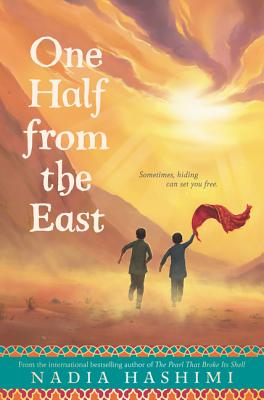
 A book so compelling you could read it in a single sitting, One Half from the East tells a story much larger than the characters involved. Nadia Hashimi’s second novel follows Obayda, a ten-year-old bacha posh, or a girl dressed as a boy, living in Afghanistan. Obayda’s family turns her into Obayd to bring the family honor and with the magical hope that in doing so, their next child will be a boy.
Obayd must navigate school, people, and the world around her without her dresses, her long hair or sisters, and most of all without the confidence she had in being who she was. Along the way though, Obayd learns how to survive as a boy, how to live as a boy, doing the things she was never allowed to do as a girl. She meets another bacha posh who shows her how to fit into her new skin, and soon enough, Obayd does not want to be Obayda again. But that is the tradition of bacha posh – a young girl is turned into a boy only to bring luck and fortune to the family, not to be a boy forever.
Obayd and her friend know that the time is coming for each of them to return to their old ways of life, but now they are stuck in the middle. They are not quite girls and not quite boys, and they fear the return to a life with less freedoms, one that they don’t identify with any more: the life of a girl.
In One Half from the East, Nadia Hashimi not only exposes readers to what life in Afghanistan is like for women especially, but she also brings to light larger, worldwide questions of gender and identity. At one point in the novel, Obayda wonders what makes a girl, a girl. Her and her sisters muse whether it has to do with the length of a person’s hair, the clothes the person wears, or with how the person acts.
Obayda simply wants to be a boy, but Hashimi also questions this desire. Does Obayda want to be a boy to bring honor to her family, is it to have the freedoms she would otherwise not have? In the end, Hashimi starkly points out that learned behavior can easily become associated with “boy” and “girl,” and yet the society surrounding that culture takes those behaviors as inherent. Boys play soccer. Girls sew dresses. But a girl can just as easily learn to play soccer, and a boy can just as easily learn to sew. So what is the “boy” thing to do, and what is the “girl” thing to do?
Hashimi wrote One Half from the East as a middle grade novel for grades three to seven, but the novel is by no means strictly a children’s novel. The book is a culturally eye opening work of art that is just as moving and heartbreaking for any aged reader.
One Half from the East will be released by HarperCollins on September 6, 2016. Preorder a copy from your local bookstore.
Read more fiction book reviews at Centered on Books.
FTC Disclaimer: This book was given to me in return for a fair and honest review of the text.
 Peter Powers and His Not-So-Super Powers is your classic middle grade superhero chapter book. It’s funny, it’s quirky, it has good moral lessons, and it’s just plain fun.
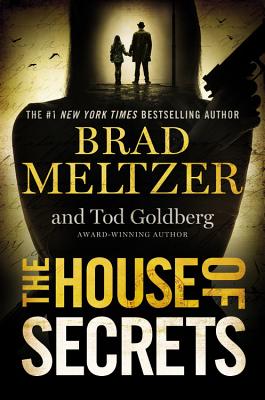 Every mystery needs to be solved. That’s what Jack Nash told his daughter Hazel when she was a child, and that’s what sticks in Hazel’s head after she wakes up in a hospital with nearly no memory of her former life. Through Hazel, Jack and other characters, Brad Meltzer and Todd Goldberg take readers on a wild ride through a myriad of conspiracies and mysteries in their latest novel The House of Secrets.
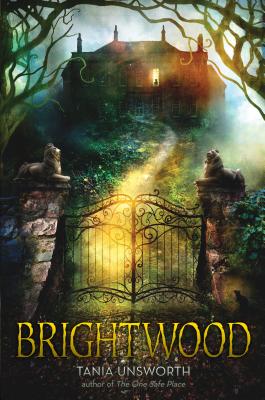 What does it mean to live fully? What does it mean to be crazy? Where do freewill, imagination, and the idea of taking chances come into play with each of these questions? Tania Unsworth probes into these inquires in her latest young adult fiction novel Brightwood.
 The Nocturnals: The Ominous Eye is the second in Tracey Hecht’s The Nocturnals middle grade series illustrated by Kate Liebman. The book follows three nocturnal friends: Dawn the fox, Bismark the sugar glider, and Tobin the pangolin, as they attempt to save their forest home from a threatening, yet seen beast.
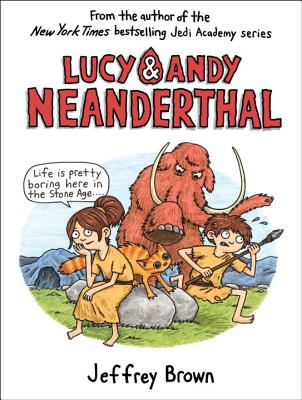 Meet Lucy and Andy Neanderthal, the main characters of Jeffrey Brown’s most recent episodic graphic novel Lucy & Andy Neanderthal. The book is a series of adventures that Lucy and Andy embark upon together from hunting mammoth to sewing clothing. Lucy is a misunderstood artistic genius, while Andy is your typical annoying little brother.
 Shakespeare never gets old, but when someone makes him new again (and in the most engaging, hilarious, and Shakespearean way), it is somehow exhilarating. That is exactly what Anne Tyler does with her latest novel Vinegar Girl. Rewriting The Taming of the Shrew in a contemporary context, Tyler takes what is one of Shakespeare’s most sexists plays and turns it into a dialogue about feminism and equality.
 Yasmine El Rashidi’s first novel, Chronicle of a Last Summer, tells a story of power, loss, and survival in Egypt during times of deep political unrest. The main character, an unnamed narrator, speaks to the reader from three different summers of her life: 1984, 1998, and 2014.
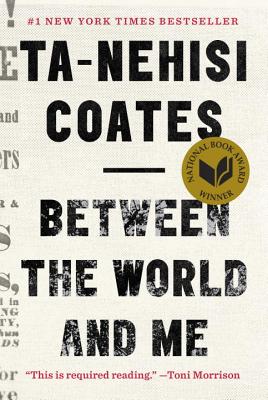 Black lives do matter because black lives are human lives. All humans are simply that: human. No matter the color of their skin, their sexual preference, or the amount of money they make in a year, we are all human. In Between the World and Me, Ta-Nehisi Coates says just this and so much more in a 152-page letter to his fifteen-year-old son.
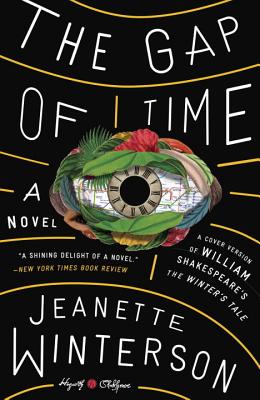 Shakespeare is arguably one of the greatest literary figures of all time. In saying this, who could ever retell his stories with, at the very least, an equal caliber? Jeanette Winterson does just this in her latest novel The Gap of Time.
 Centered on Books