“Khirbet Khizeh” by S. Yizhar

Khirbet Khizeh Book ReviewKhirbet Khizeh is S. Yizhar’s fictionalized account of life as a soldier in the Israeli army during the 1948-49 war, and was published shortly after the war’s end. In this new translation by Nicholas de Lange and Yaacob Dweck, Khirbet Khizeh takes on a renewed poetic significance, instilling the novellas enduring relevance for contemporary culture.

The narrator starts his account by noting that the event he is about to describe “happened a long time ago, but it has haunted [him] ever since.” He talks of the passage of time and his once hopeful idea that such a passage might have healed his sorrow and despair. However, it appears that nothing of the sort has come to pass. He takes readers back to the beginning, back to his own mindset before he was deeply disturbed by his and his cavalry’s actions.

It is a “splendid winter morning” the day that the troop “cheerfully making [its] way” across the countryside. As they are travelling, they come across the village of Khirbet Khizeh which they are told, by radio, that they must attack in order to dispossess the Arab’s who live there of their land. The infantry must, however, wait for the command do so. And so they wait. They grow restless, sleepy, and confrontational with one another as time seems to interminably pass for them. The narrator feels the pressure of wanting to act, for as he notes, in idleness “thoughts would stealthy creep in.” And “when the thoughts came, troubles began;” nobody want thinking soldiers, so “better not to start thinking” he resolves.

The indifference, lack of concern and general passivity of the soldiers continues as they talk and laugh of slaughtering a donkey for the fun of seeing just how long it would keep munching on grass after being shot three times. “What incredible vitality” the wireless operator observes. This scene foreshadows the stance of observance that the soldiers, and most especially Yizhar’s protagonist, takes on as the novella progresses.

Finally the group is “rescued from [their] distress” and given the green light to open fire on Khirbet Khizeh. The attack begins, and the rest of the piece details the narrator’s indecisions, frustrations and doubts concerning the rights of the Jews and the rationality of their actions. He develops a sudden sense of compassion for his enemy: mostly graying men, steadfast women and crying children – none of whom retaliate as they are herded from their homes. The narrator recognizes this change of heart in himself, but notes that at the time he “didn’t want to stand out from the others in anyway,” and so he tries his best to keep quiet.

He is, however, eventually compelled to speak out to his commander Moishe, that “it’s not right” for the Jews to displace the Arabs when they are so defenseless and passive. Moishe though is entirely indifferent and points out that if the Jews were in the Arab’s position right now, the Jews would be dead. He warns Yizhar’s narrator that if they don’t take care of the Arabs now, the group will present bigger issues for the Jews in the future. The narrator continues to argue with himself, but ultimately decides “this is war!” Though he does not by any means fully convince himself that his actions are just, he has at least subsumed his outward expression of guilt and questioning beneath the guise of wartime allowances.

As David Shulman notes in the afterword though, Yizhar’s expression of “all is well in war” gains greater irony in the fact that not much has changed in Israel now that the war is over. People are still being displaced, people are still hating and killing one another, and yet the excuse of war can no longer be used.  Though it might appear that the novel bends on a moralistic theme, Shulman notes that Yizhar’s narrative hinges more on choice than on morality. Perhaps these choices are necessarily tethered to morality as they are intimately bound to the notion of peer pressure both in the form of people and ideologies.

The text spans a mere 144 pages, and Yizhar propels readers directly into both the internal and external action of the novella, keeping them there throughout. Usually with translated text, there is a profound sense of loss and sadness surrounding the physical words on the page because they are merely representations of the original words used in the native language. De Lange and Dweck, however, capture with verve the poetic essence of the text beautifully and aptly. Yizhar’s very Dickens-like sentences build into paragraphs that wind around your heart, pulling you forward into the action, the distress, and the ambivalence that characterizes his work.

This new translation by Nicholas de Lange and Yaacob Dweck was re-released by Farrar, Straus and Giroux in December of 2014 and can be found at your local bookstore.

Read more fiction book reviews at Centered on Books.

FTC Disclaimer: I received this book from NetGalley for a fair and honest review of the text.
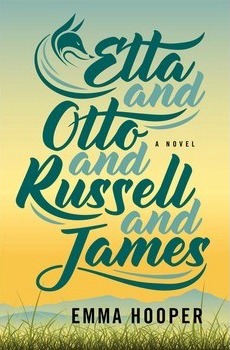
“Etta and Otto and Russell and James” by Emma Hooper

Etta and Otto and Russell and James Book Review.Etta and Otto and Russell and James is an adventure into heartache and love, into loss and fulfillment, and into the inevitability of time’s passing. Written by Emma Hooper, the novel spans a wide range of human experience to encapsulate the profound joys and sadness that are found in simply living.

Etta has decided to leave the farm where she lives with her husband Otto in order to see the ocean, an element of nature that in all of her 83 years she has never experienced. She leaves Otto a letter detailing where she has gone, and asks him not to worry, as she will do her best to remember to return.

Within pages, the reader experiences the gyration between past and present that serves as the textual framework for Hooper’s novel. The author develops her characters in a backward, inside twisted arch that allows for greater understanding and empathy on the part of the reader. Hooper guides us through the intricacies of each character’s past, so that we can become acquainted with the patterns and traumas that have shaped the elderly trio we meet in the novel’s beginning. This trio is completed by Russell, the Vogel’s neighbor and childhood friend.

Though the novel at first seems straightforward and thoroughly candid, we soon find that there is a magical realism that permeates the pages of Etta and Otto and Russell and James. This magic presents itself at different points in the novel as talking coyotes and flying children among other things. These elements perfectly capture the arch of aging as they are transformed from childhood imaginings to the beginning stages of dementia. At times these magical elements can become confusing or distracting, especially when it’s not entirely clear what purpose they are serving. However, as mentioned above, the allusions that these fantastical elements make lie perfectly with the novels themes and threads. To thoroughly enjoy the novel, readers must recognize that not every moment will be methodically fleshed out or explained.

After all, the fissures that Hooper creates in the narrative are what give the text its richness and depth. Her minimalistic style mirrors the letters Etta received from Otto during the war: full of holes. Holes that characters attempt to fill ceaselessly, holes that Etta feels she must go to the ocean to fill, literal holes in memory, and metaphorical holes in hearts. The book is littered with these voids that call to be filled, some of which can never be filled, and some of which characters are too afraid to even attempt filling.

Etta and Otto and Russell and James is a story about letting go; a story about cutting ties with all of the things that don’t serve you (including feelings of guilt), about living each moment fully, and about embracing everything around you with love. Though at times heart wrenching, the novel encourages readers to treasure and recognize the meaningful experiences that make up a life, even if those memories and experiences might be slightly, or profoundly, tragic.

Published by Simon and Schuster, Etta and Otto and Russell and James was released January 2015 and can be found at your local bookstore.

Read more fiction book reviews by Centered on Books.

FTC Disclaimer: I received this book from NetGalley for a fair and honest review of the text.

‘Jillian’ by Halle Butler

Jillian by Halle ButlerTeacher and author William Haywood Henderson once said that if writers avoid uncomfortable situations and issues in their writing, their work “will suffer from a lack of intensity and edge…The deeper [the author goes], the more distinct, striking, and moving [the] novel will become.”

In her debut novel, Jillian, author Halle Butler charges into the territory of the perverse, the grotesque, and the downright ugly side of human nature that Henderson claims is essential to the verve and passion of great literary artworks. Butler’s characters are awful, hate-able, and sometimes sickeningly relatable, and this relatability is the true mark of intrigue for the novel.

Jillian is told from the perspectives of Megan, Jillian, and once and while an oddball character like Crispy the dog. Megan and Jillian work together in a colonoscopy office – which is about the only thing they think they have in common. Megan is a 24-year-old sulking, borderline alcoholic who finds – not joy, but perhaps meaning (?), fulfillment, (?) necessity (?)  in criticizing and belittling others in her own mind. Jillian is her arch nemesis for no other reason than Jillian’s ignorance, annoyance to Megan, and her vastly different worldview. Jillian is a 35-year-old single mother who is the poster woman for self-help, mantra repeating, positivity in the most obnoxious way imaginable.

At first the characters seem harmlessly broken, maybe slightly macabre; but, within a few pages, the true grotesqueness of their respective personalities is revealed. You gain insight into Megan’s intense jealousy – which is relatable in and of itself, but Megan’s approach to dealing with that jealousy is cringe worthy. She not only hates everyone who has anything that she doesn’t, but she goes out of her way to confirm her hatred by making fun of them and picking them apart to her boyfriend Randy. Unsurprisingly, Megan is also so terrified of herself and her own potential for failure, that she makes no attempt to better herself in anyway. Wallowing in the drudges of her own sea of self-pity, Megan’s stagnancy is poignant and if nothing else, motivating for readers to actively seek to be otherwise.

Jillian, on the other hand, is constantly trailing off into fantasies of new dream jobs and illusory relationships, aptly able to irrationalize herself out of every serious situation in which she is put. Ignorance doesn’t even come close to summing up Jillian’s complete removal from, and disregard, for the real world. Her idiocy, lack of perspective, and overall hideously optimistic unrealism is enough to want to make the reader puke; and yet, there are moments of relatability with Jillian too. We’ve all tried to talk ourselves into feeling one way when we really feel another, we’ve all had experiences that we wish we could change, and we all know what it is to ignore the signs of catastrophe; though hopefully, we more tactfully deal with these issues.

As we engage with these two women, we begin to see the similarities among their apparently vast differences. We see the common elements of human struggle, of human selfishness, of removal from and lack of acceptance of reality, of complacency and the different methods of dealing with the sometimes static condition of life.

Raw, cutting, primeval and engaging in a terrifying way, Butler’s 150 page book will take you a few flicks of your wrist to get through. For however powerful it is though, thank god it’s so short, because it makes you feel like you’re locked in a damp cage, naked and caked with dirt, while everyone is looking at you as you struggle to breathe.

Yes, exactly like that: a little bit the way life feels sometimes.

Slated for release in February of 2015, you can pre-order Jillian at Curbside Splendor.

Read more book reviews of small press published work at Centered on Books.

Disclaimer: I received this book from Curbside Splendor for a fair and honest review of the text.
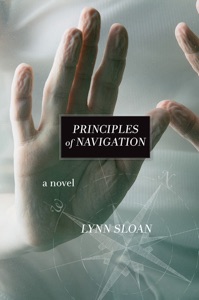
‘Principles of Navigation’ by Lynn Sloan

Principles of Navigation by Lynn SloanA story of love, hatred, selfishness, faith and most importantly, the dualities bound up in being human, Lynn Sloan’s captivating first novel Principles of Navigation is a psychologically tormenting exploration of the human condition. Alice Becotte wants a child more than, and at the cost of, anything else in her life or anyone else’s. Her husband, Rolly, an artist and university professor at a local Indiana college, is much more concerned with creating art and living by the ways of passion than he is with having children or settling into a traditional idea of family life.

At first, the novel focuses primarily on the struggles of Alice and Rolly’s marriage as well as the difficulties bound up in their seemingly incompatible relationship and tumultuous love for one another. However, as it progresses, Sloan veers readers off their perceived course toward plot bumps of infidelity, loss and more internal struggles.

At fundamental odds with one another, Alice and Rolly vacillate between affection, annoyance, and adoration for one another – as will you, the reader. Throughout the book, you will both love and hate each character a hundred times over and more. Sloan threatens to break readers to pity, to disdain and to compassion as each character showcases the spectrum of his or her duality. Nobody is a reliable narrator, and (or perhaps because) nobody is a static character. This is what makes Sloan’s novel so fascinating and gripping. Just as in life, no one person is the protagonist or antagonist – each character becomes another’s antagonist, or their own, as they navigate the waters of life’s imperfections and unfairness, as well as the consequences of their own actions.

There is nothing about Principles of Navigation that segregates it to one particular genre, nor does it target one group of readers. The book raises questions that are essential to every reader’s life: questions of humanity, love and growing older. Questions that will propel you from page one to the end of the novel without a backward glance as you are ripped through the pages of Alice and Rolly’s tumultuous lives.

Sloan, already a success in the field of short story writing and photography has broken into the novel industry with a strength and vivacity that will be sure to propel her into the ranks of great American novelists. Published by Fomite Press, Principles of Navigation is scheduled to be released February 15, 2015.

Read more fiction book reviews at Centered on Books.

Disclaimer: I received an advanced copy of this book for a fair and honest review of the text.
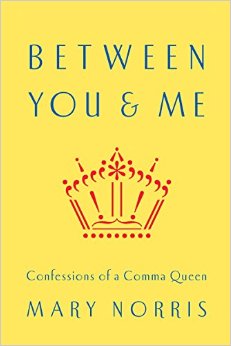
‘Between You & Me: Confessions of a Comma Queen’ by Mary Norris

Cover of April 2015 release Between You & MeBetween You & Me: Confessions of a Comma Queen is copy editor Mary Norris’ autobiographical style manual of sorts detailing her own voyage to The New Yorker’s copy desk and her encounters with the god- awful grammar she’s had to face at her job and in her everyday life. Not in any way diminutive or overbearing, Norris’ stern but open-minded perspective offers rules more as suggestions based on context rather than mandates required by grammatical law. Constantly throwing out expletives (not to mention an entire chapter on the inclusion of obscenities in print) and always roping in an air of comedy, Norris’ book is much more than just a style guide or grammar book: it’s a fun and inspirational glimpse into the success of a hardworking, resilient, language-loving woman.

Between You & Me features lessons on who vs whom, the correct usage of colons and dashes, as well as issues concerning apostrophes in our contemporary, digital, sales-driven age. Aside from these, though, are chapters delving into the history of the pencil, Norris’ relationship with her transgender sister (which she uses to illustrate the issues surrounding pronouns), and snippets of linguistic history. The author never fails to tie her personal life back to the didactic center of the book in a way that both enhances the lesson being taught and provides a tether of empathy to Norris so that the reader cares about her as the book’s author and not just the narrative voice.

For any English major who has doubted her choices in education, Norris’s story is divinely motivating as she details her early years working in a cheese factory and her journey  to The New Yorker offices. For any writer, editor, or human being who has ever felt an ounce of doubt concerning the work that she creates, Norris stands as an archetypal model for making mistakes and moving past them. She constantly refers to grammatical blunders she’s made herself or missed in editing, and she often questions her own grammatical judgment. But wait, she’s a copy editor at The New Yorker! Shouldn’t she know everything? Shouldn’t she be perfect? Norris makes very clear that she’s human, just like every other person in the world who experiences self-doubt. She not only admits her mistakes, but she embraces them and explains to the reader what she’s learned from them.

Aside from purely grammatical insights, Norris also breaks into the philosophy and ethics of grammar with the advent of feminism and other cultural shifts related to gender, technology, social media and more. She brings to light issues and conversations that are very much alive in the cannon today, and offers insight, perspective and opinion, though she often admits that there is no easy answer to the grammatical wonders of our world. As she states, particularly in relation to the comma, but as a metaphor for grammar and the book as a whole: “…follow some rules, sure, but in the end what you’re after is clarity of meaning.”

Norris may be adamant about certain grammatical rules, like pronouns matching their antecedents, but there are others that, as she points out, are subject to the particular style manual of the publication a person is writing for – and then of course there is the issue of personal preference, and then there’s also the necessity for clarity. She drives home that making yourself crazy over a single misplaced apostrophe is not worth extreme anxiety: recognize it, pick up, and move on.

Overall, Norris provides goddess-like insight into common yet difficult grammatical issues with clarity and ease of understanding while keeping readers engaged with humor, history and a sense of humanity.

Scheduled for release from W.W Norton & Company in April 2015, Between You & Me Adventures of a Comma Queen is the perfect book for any literary lover and a superb choice for any reader interested in language. Pre-order the book from your local bookstore today!

Read more nonfiction book reviews at Centered on Books.

Disclaimer: I received an advanced copy of this book for a fair and honest review of the text.
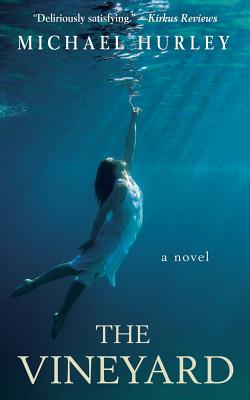
‘The Vineyard’ by Michael Hurley

Chicklet novel, The Vineyard, by Michael Hurley

Michael Hurley’s The Vineyard stakes its plot in three friends, Dory, Charlotte and Turner, coming together for a summer at Martha’s Vineyard. Each woman is plagued by a weight of despair hanging from her past which independently drives her to seek out the comfort of companionship and escape.

Charlotte has recently lost a daughter to cancer and a husband to the indifference caused by their daughter’s death. Dory is fending off the unwanted attention of longtime admirer Tripp Wallace, her mother, and her waning health. Turner is battling the internal demons of self-doubt and fundamental discontent with her failed relationships and lackluster career. Throw Enoch, the mysteriously ephemeral  fisherman who illegally sells the most delectable shrimp in town during off-shrimp season, into the mix, and you’ve got a narrative full of comedy, mystery, shock, and scandal.

Each woman struggles to the edges of physical death and moral doubting in order to come to terms with her own sense of self and to divine her purpose in the world at large. Hurley spins his novel from a somewhat dismal chicklet tale into a reeling mystery and crime novel as he aptly navigates questions regarding faith, the meaning of love, and the power of friendship.

The novel is propelled forward by a constant shift in plot as numerous threads are picked up and woven together throughout the progression of the story. At times this constant shifting, though, can be distracting and can halt the momentum of the novel. The shock value of each turn of events, however, picks up the often frenetic storyline, putting it back on track and providing a rather rousing impetus to keep trekking through.

Despite being a plot driven book, The Vineyard does justice to its underlying themes through Hurley’s strength in character development. The characters, if nothing else, are worth the entire journey. Each is so fully flushed out, so entirely herself, that you could blot out the names from the page and still comprehend each moment in the novel. Hurley does a fantastic job of creating characters that readers will fall in love with, despise and identify with on levels both desirable and unattractive.

Published by Ragbagger Press in November 2014, you can find this book at your local bookstore.

Read more fiction book reviews at Centered on Books.

FTC Disclaimer: I received this book from Netgalley for a fair and honest review of the text.

‘The Amazing Adventures of Kavalier and Clay’ by Michael Chabon

Pulitzer Prize Winning One Book One Chicago Michael Chabon novel is reviewed by Centered On Books.

The Amazing Adventures of Kavalier and Clay by Michael Chabon.

While Michael Chabon’s The Amazing Adventures of Kavalier & Clay is the story of two comic book writers living in New York City in the early 1930s, it is, at the same time, an exploration of the universal condition of being human, of the unique condition of being Jewish during World War II, and of the incessant quest for self- discovery that traverses all and every plane of human existence.

At the beginning of the novel we meet Josef Kavalier, a young Jewish boy who has just escaped, rather epically, from Prague. With the help of a golem and at the expense of what small means his family could gather, Josef has made it out of Nazi-occupied Europe to New York to live with his cousin Sammy Klayman and his aunt Ethel. Sammy, a nineteen-year-old aspiring artist working as an illustrator for Empire Novelty, discovers within the first few hours of meeting Josef that his cousin is a superb artist far beyond Sammy’s own talents, and he immediately dreams up the possibility of starting a comic book series with Josef. The cousins pitch the idea to Sammy’s boss and in the Golden Age of comic books, the money-hungry mongrel Sheldon Anapol can do anything but turn the boys down.

Joe, having left behind his family in Prague, feels a looming sense of guilt in the wake of his freedom and seemingly unmerited job. In order to offset this agony, Joe centers all of his art on anti-Nazi themes and supplements his war efforts by fighting, or attempting to fight, any German he can find in New York City – and he happens to find quite a few. A reticent and stubbornly introverted young man, Joe cannot seem to express his own self-torment, his love or any part of his emotional self.

While Joe is fighting the internal battles of guilt and shame over his external situation, Sammy is fighting a battle with similar sentiments but in terms of his art, and most especially his sexuality. He is lonely, fatherless, and oddly uninterested in forming romantic relationships with any woman he meets. Constantly questioning his own feelings towards others, in particular his jealousy toward Josef’s girlfriend (but not Josef himself), Sammy is at odds with his sexual orientation in a time and place when such thoughts were so taboo, Sammy can’t even identify that this is his struggle.

The young men negotiate the difficulties that accompany success, love, failure and loss; they confront the harsh realities of imperfection, of ageing and of the restrictions and expanse of their own morality as they grow in their artistry, their familial ties and their humanity.

The novel holds the space between literary, historical and surrealistic fiction at times spotlighting on Joe and Sammy’s comic book characters and at other times featuring historical figures such as Salvador Dali. Chabon’s artistry with words (just sample this: “The cold jerked his chest like a wire snare. It fell on him like a safe. It lapped eagerly at his unprotected feet and licked at his kneecaps.” [430]) is equally matched by the novel’s moral direction and inherently philosophical bend. Themes emerge throughout the novel, are picked up, threaded through other themes and woven together in a seamless tale that never quite goes where you are expecting it to. Themes of self-expression, self-discovery, escapism (in all positive and negative senses of the word) and most thoroughly self-liberation, are only a few of the threads Chabon draws upon.

If you’re in any way shy or reserved, don’t read this book in a café or any other public place: expect multiple jaw dropping moments, laugh-out-loud scenes and characters you will fall so in love with that you will forget you are reading anything but the story of your own life in the guise of previously unfamiliar names, places and expressions you’ll soon forget you didn’t know before.

Though, as with any great novel (and this is sure to join the ranks of the American classics), the first 130 or so pages aren’t as fast paced as the rest, the benefit of patience (if you happen to be impatient) is well worth the wait: once you hit page 145 the book will haunt you every moment it’s not in your hands with its covers spread.

Published by Random House in 2012, you can find Michael Chabon’s The Amazing Adventures of Kavalier & Clay at your local bookstore.

Read more fiction book reviews at Centered on Books.