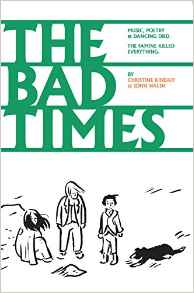
‘The Bad Times’ by Christine Kinealy and John Walsh

the-bad-times-walsh-kinealyThe Bad Times by Christine Kinealy and John Walsh is a graphic novel that tells the story of how “music, poetry and dancing died,” during The Great Famine in Ireland. Despite this statement though, through its very existence, The Bad Times stands as a testament to the resilience and revival of Irish culture after such devastation.

The story takes place in Kilkee, County Clare between the years of 1846-1849. Kinealy and Walsh follow three young friends and a dog (Brigit, Dan, Liam and Cu) from the beginning of the famine until its devastating conclusion. Brigit and Dan come from lower class farming families, while Liam’s father owns a shop and ends up profiting from the famine. Yet, despite these differences, their friendship never wavers. In fact, its very durability offers moments of clarity where the reader sees that despite starvation and death there is still a sense of humanity, of understanding and of love that supersedes greed and the need for survival.

Among other themes, Kinealy and Walsh also explore faith and the role of religion in a young person’s life when faced with adversity. The young trio is also confronted with loss, young love, the folly of pride and more throughout their three year journey together. Though the graphic novel doesn’t end quite happily, there is at the very end a grand gesture of generosity, a proclamation of love, and the hope for renewal.

When it comes to the art, Walsh does a fantastic job of fitting the style with the storyline and themes of The Bad Times. The colors are often dark and overcast, with pops of pigment that remind the reader of the possibility that lies beyond the obscurity and gloom. The stylistic choices for depicting the characters also scream “famine” with bagged eyes and a certain feeling of agedness that pervades the young characters.

As for the dialogue, Kinealy intersperses Gaelic phrases along with the colloquial Irish dialect. Though the authors never explain the exact meaning of the utterances woven in, the Gaelic doesn’t detract from the intelligibility of the piece and instead imbues it with a certain resonance, a reminder of what was lost with the death of so many.

The Bad Times is a riveting and momentous graphic novel that teaches readers about the actual historical event of The Great Famine, while also weaving in important elements pertinent to adolescence and humanity at large.

Published by Quinnupiac University Press in 2015, The Bad Times is available for purchase here.

Read more fiction book reviews at Centered on Books.

FTC Disclaimer: This book was given to me in return for a fair and honest review of the text.
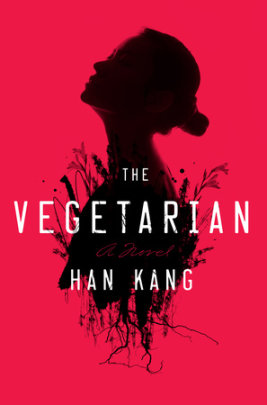
‘The Vegetarian’ by Han Kang

the-vegetarian-han-kangWhat is the difference between living and enduring? What is life when it is controlled by someone external to yourself? What is reality and how do we know that the place our physical being resides in is it? Among many other esoteric questions, Han Kang tackles these in her novel The Vegetarian. Addressing issues of abuse and the effects of trauma on the human psyche, Kang provides a unique glimpse into the convergence between sanity and insanity.

At the beginning of the novel, Yeong-hye has just become a vegetarian. Living in a very patriarchal Korea, Yeong-hye is berated by her husband for not eating meat herself or cooking it for him. The most interesting aspect of the first section of Kang’s novel is the fact that it is not told from Yeong-hye’s perspective, but from her abusive and oblivious husband Cheong. The reader feels even more intensely for Yeong-hye’s plight in hearing the misogynistic remarks that come from Cheong’s mouth. The skewed lens through which he views his wife as an object only serves to fuel the rampant anger we build for Yeong-hye.

The next section is told from the perspective of Yeong-hye’s brother-in-law, a washed up artist who when we first meet him is imbued with the passion to pursue a new artistic project: that of painting his sister-in-law in flowers and filming erotic visions of her. The reader is once again privy to the working of the patriarchal mind. In viewing the objectification of both Yeong-hye and her sister In-hye, the horror only continues.

Throughout the course of the novel Yeong-hye struggles with anorexia and eventually appears to be losing her sanity. The men around her can’t fathom why she is going to such great lengths to reclaim her body and herself: it is only her sister who can relate in some distant sense to the horrors that Yeong-hye has experienced. The final portion of the novel is told from In-hye’s perspective, and in accessing the female mind, we are also granted better access to Yeong-hye herself. In seeing herself in Yeong-hye, In-hye begins to question the very fabric of reality and the lines between lucidity and insanity.

The Vegetarian is a tragic and beautiful tale of the terror that abuse brings, and the lengths to which the abused will go to assert their power

The Vegetarian was original published in 2007, but was recently translated to English and published by Hogarth Press in 2015. You can purchase a copy of The Vegetarian at your local bookstore.

Read more fiction book reviews at Centered on Books.

FTC Disclaimer: This book was given to me in return for a fair and honest review of the text.

‘Lost Birds’ by Birute Putrius

lost-birds-putriusLost Birds by Birute Putrius is very much a story of loss, change and the ability to adapt to both. Following a slew of displaced persons from Lithuania, Lost Birds tells the tale of what it means to feel an outsider in your home, your country and your overall life.
Putrius, a displaced person (DP) herself, relays the story from multiple perspectives so that the reader can see what it means to be a DP from all angles. Each chapter is told from a different viewpoint, and Putrius follows each of her characters from childhood into middle age. With this timelines, the reader grows up with the characters beginning from the moment they set foot in America.

Although at first the novel focuses primarily on what it means to leave your homeland and feel a foreigner in a new unknown place, the book quickly takes on even more issues that are pertinent not only to DPs, but to the human condition itself. Themes of acceptance, unrequited love, mental illness and spirituality all play a lead role at one point or another in the novel. Characters find and lose themselves as the years pass, and in the end, Putrius seems to be telling us that perhaps there’s no other way to live than to lose and find yourself over and over again.

Each character is interesting and engaging in her own way; however, the multiple changes in perspective and point of view can sometimes give the novel a bit of a disjointed feel, as if each chapter is its own short story, complete in itself. This aspect doesn’t detract from the overall emotionality of the novel or its arc, but it does call itself out often enough to distract the reader now and again.

Despite the intermittent disconnect between chapters, Lost Birds is a thrilling book that discusses issues not only relevant to displaced people of any kind, but to the condition of being human.

Published by Birchwood Press in December of 2015, Lost Birds is available at your local bookstore.

Read more fiction book reviews at Centered on Books.

FTC Disclaimer: This book was given to me in return for a fair and honest review of the text.

‘Cats in Paris: A Magical Coloring Book’ by Won-Sun Jang

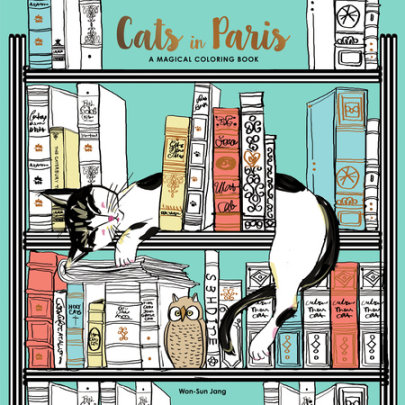
cats-in-paris-jangTake a step through the threshold of human reality into a magical world filled with Cats in Paris. The coloring book Cats in Paris, designed and illustrated by Won-Sun Jang, is a delightful and endearing collection of drawings that are fit together as a sort of fragmented narrative.

Adult coloring books are storming book, art and drugstores all over as a catalyst for relaxation and leisure. Jang’s particular coloring book, though, follows an unnamed cat through the streets of Paris. Colorists are brought everywhere from the Eiffel Tower to the Shakespeare and Company Bookshop, to a place called home.

The pictures themselves are geared toward the rebel colorist who aspires to color outside of the lines. Many of Jang’s illustrations are filled with unclosed lines and wide open spaces that leave a lot to the imagination of the colorist.

Cats in Paris: A Magical Coloring Book is the perfect gift for any cat lover or admirer of Parisian culture, or for yourself to just sit, relax, and let your imagination wander.

FTC Disclaimer: This book was given to me in return for a fair and honest review of the text.

“NeuroTribes” by Steve Silberman

neurotribes-silbermanNeuroTribes by Steve Silberman is the pinnacle of understanding of autism as it’s developed from its initial coining, to autism in the current age. Silberman goes not only into historical depth concerning autism and its development over the course of its clinical existence, but he also incorporates anecdotal and first hand experiences of both parents of autistic children and autistic people themselves.

Silberman starts by tracing back the history of autism to its founders, namely child psychologist Leo Kanner and clinician Hans Asberger. From here Silberman discusses the man instantiations that autism took on a clinical level throughout the years, from those believing it was only a childhood “disease” to those who believed autism could be “cured” through punishment based therapies and even more horrifying methods.

Weaving in anecdotal stories of parents struggling to find services for their children, Silberman eventually turns the book almost completely on its head by putting the bulk of the focus on autistic people and their experiences, contributions and methods of dealing with “typical” society.

All along, Silberman advocates for the importance and necessity of having diverse thinkers in our culture: i.e. “neurodiversity.” Pointing to notable figures in the past who were likely to have been autistic (had the term been around at the time), such as Henry Cavendish, Silberman makes the argument that without these thinkers we would be far behind in the realm of science and philosophy.

Overall, NeuroTribes is both an inspirational and terrifying look into how views of autism have developed and evolved over time, and how autistic people have gained greater recognition as humans with a different way of thinking and nothing more.

Published by Avery in 2015, NeuroTribes is available at your local bookstore.

Read more nonfiction book reviews at Centered on Books.

FTC Disclaimer: This book was given to me in return for a fair and honest review of the text.


‘The Fugue’ by Gint Aras

the-fugue-gint-arasWhat is truth? What is love? What is living, and what does it mean to truly live your life? These questions only brush the surface of inquires that Gint Aras makes in his latest novel The Fugue. A book about family, about belief, about the deepest, darkest corners of the human condition, The Fugue is an exploration of humanity on the highest level.
A fugue is defined either as “a polyphonic composition based upon one, two or more themes,” or “a period during which a person suffers from loss of memory, often begins a new life, and, upon recovery, remembers nothing of the amnesic phase.” Aras draws on these definitions both literally and figuratively throughout the whole of The Fugue.  The novel weaves together multiple characters’ storylines and arcs so that they all intersect at various points throughout the novel. Coming together at the highest points of climax, jumping out of the woodwork to incite complete surprise, and slowly building to be easily foreseen, Aras does a fantastic job of intertwining each individual plot together into a cohesive, riveting and complete novel.

If you were to name a main character it would have to be Yuri Dilienko, who we meet just as he is being released from prison for the murder of his parents. Though Yuri might be considered the nexus around which the story revolves, Aras grants us access to many other characters’ minds; including, both of Yuri’s parents’, his lovers’, the great composer Lars Jorgensen, a local priest, and more. Each chapter focuses on a different character and each section dials in a specific point in time. Ranging from February 1940 to the summer of 2001, Aras forces us to grow, change and mourn with his characters as they do the same.

At any point in the novel you can hate, love, pity, and be terrified by any character who only a chapter ago you felt the exact opposite feeling for. Aras’ characters are dynamic in a way that only human beings are, with flaws so tragic readers can’t help but be reminded of their own tragic flaws and find sympathy for even the most damnable character.

The Fugue is a masterpiece of literary fiction that echoes novels like A Tree Grows in Brooklyn, Les Miserable and To the Lighthouse with its cross generational plotline and deep-seated narrative about the struggles, sadness and often futile nature of life. Glimpses of hope shine through at the rarest instances, and shreds of light are shined on certain characters who rise above the slog for moments in time, but overall The Fugue is a tale of trauma and the dark power of hatred.

Beautifully composed and entirely unforgettable, Gint Aras’ The Fugue is a must read for the year.

Available for purchase at your local bookstore, The Fugue was published in December of 2015 by Chicago Center for Literature and Photography.

Read more fiction book reviews at Centered on Books.

FTC Disclaimer: This book was given to me in return for a fair and honest review of the text.

‘Beware of Napkins’ Written by Jack Murphy and Illustrated by Melanie Jeanne Plank

bewareofnapkins_murphy_plankIn a hybrid form of poetical artistry, author Jack Murphy and illustrator Melanie Jeanne Plank have created the ultimate literary tribute to one of the greatest rock and roll bands of all time, The Beatles. The title of their book of illustrated poetry, Beware of Napkins, plays on George Harrison’s 1970 song “Beware of Darkness.” This misheard song title features as the main narrative thread for the collection as the signing off of an unnamed father to his daughter Jessica in a series of letters that spans from Jessica’s childhood to motherhood.
Aside from the letters between Jessica and her father, of which we are only privy to Dad’s side, there are also a series of portrait poems about each of the members of The Beatles, as well as shout outs to particular songs, and highlights of their individual and collective careers. Covering topics of hypocrisy, the price of fame, selling out, and the whole Yoko controversy, Murphy and Plank do a splendid job of providing not only an overview of the band’s career, but also imagined snippets into their souls.

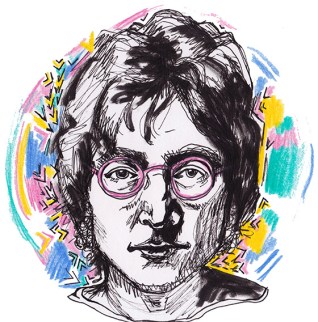
While Murphy’s poetry wraps the reader in sentiment, nostalgia and comedic relief, Plank’s illustrations are the perfect aesthetic and emotional accompaniment. From her realistic portraits from John, Paul, George and Ringo, to her cartoon-like drawings of beach chairs and her handwritten letters, each piece is the exact physical manifestation of the more ethereal emotion that Murphy attempts to convey.

There may be inside jokes and obscure hints that the lay reader won’t necessarily understand, but these do not detract at all from the overall piece if you don’t have the knowledge needed to understand them. Beware of Napkins is hilarious, heart breaking and intimate whether you are a hardcore Beatles fan or just one of the everyone who at least knows who The Beatles are.

Beware of Napkins is available for purchase at JackMurphyChicago.com

‘Meditations on Intention and Being’ by Rolf Gates

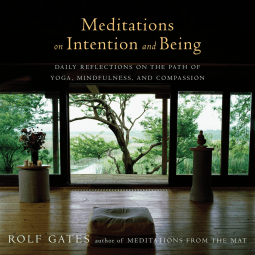
meditations-on-intention-and-being-gatesMeditations on Intention and Being by Rolf Gates is a sort of seven step how-to that guides its reader toward the process of “starting over.” Gates’ hope in writing the book is to “provide readers with an ancient set of instructions for how to live and love well” which the author claims requires and understanding of many principles that are inherent to the practice of yoga. In each chapter Gates provides one more way of reaching the above goals based on yogic, Buddhist, and Christian precepts.

Gates, a recovered addict, retired military personnel, and former addictions counselor is now a yoga teacher trainer who aims to inspire and encourage his students to access the deeper aspects of the yoga practice that often get lost in the more contemporary and mainstream styles of practicing. Gates though does not discriminate against any one type of yoga despite that fact that he himself has developed and teaches a particular style of 90 minute classes. He admits that most people come to yoga for its physical benefits and challenges, but that this can be the gateway to accessing the more personal and spiritual elements of the practice.

Themes of effortlessness, nonviolence, spirit, mindfulness, compassion, equanimity, and intention are the primary focuses for Gates. He delves into each in great detail providing not only an outline and introduction to what each of these concepts means to him, but also giving in-depth autobiographical background concerning his own experiences with these ideas. Though in some ways this autobiographical content lends legitimacy and weight to Gates’ arguments, it can at times become overbearing and tiresome. There are points where the actual intention in writing about a topic seems lost in a sea of narrative that, though related, isn’t always entirely relevant to a reader who is not intending to read an autobiography.

Above all presence and awareness are most prized by Gates and touted to be the most important elements if one wants to live life well. An essential and integral part of yoga, presence is what allows humans to actually live their lives rather than experience them from a distance, and this seems to be what Gates is getting at through his long and intricate examinations of each step toward presence. Though some of the chapters can be long and difficult to push through, the overall message of the book is one that is important for our current culture, and makes Meditations on Intention and Being a very relevant book for our times.

Published by Anchor in December 2015, Meditations on Intention and Being can be purchased at your local bookstore.

Read more nonfiction book reviews at Centered on Books.

FTC Disclaimer: This book was given to me in return for a fair and honest review of the text.

‘2 A.M. at the Cat’s Pajamas’ by Marie-Helene Bertino

2am-at-the-cats-pajamas-bertino2 A.M. at The Cat’s Pajamas by Marie-Helene Bertino is the tragi-comedy of 2015. With pages full of characters that not only pull on the core of your heart, but annoy and baffle you to no end, Bertino does an excellent job of capturing what it is to be human: imperfect, beautiful, ugly and loved.

The cast of characters that make their appearance in 2 A.M. at The Cat’s Pajamas ranges from nine-year-old Madeline, a motherless vagabond with an abusive father, to her teacher the love-lust Sarina, to the gruff owner of the night club The Cat’s Pajamas, Lorca, who is about to lose his club because of violated city ordinances. These are only a few of the featured characters into whose heads we are allowed access, among others are Pedro the dog, Madeline’s father, Madeline’s pseudo caretaker, and Madeline’s principle.

At first, Bertino’s head hopping is a bit jarring, and makes 2 A.M. at The Cat’s Pajamas hard to fully delve into. It takes a bit of time to become acclimated to not only Bertino’s style of jumping from character to character, but also to the characters themselves; since, in all the jumping, readers aren’t able to get to know the characters as well so quickly. However, once you settle into Bertino’s style, the novel careens off at high-speed, and each section is a drum roll for a new character that you can’t wait to hear about. You begin to fall in love with Sarina and Madeline, with Lorca and his son, while chastising them for their impatience or ignorance or lack of action, while at the same time realizing these are many of the actions that we all tend toward for a majority of our lives, especially when it concerns anything important.

Bertino captures the human essence in this way. She shows it in the way that everyone is a little bit self-doubting no matter how talented or hard working they are, in the way that we can’t help but love the people we love even if they treat us poorly and especially if we are children, in the way that love is unexpected and shows up just when you need it most but when you are expecting it least, in the way that we often treat the ones we love with harshness out of love, out of protection. Bertino reminds us that no one is perfect but that we can all be loved and love ourselves if we just let go a little bit. Even the most terrible characters in the novel you can’t help but love by the end and find empathy for them in their plights.

A sort of backwards fairytale that doesn’t necessarily have a happy ending, but ends more happily than it begins, 2 A.M. at The Cat’s Pajamas is beautiful and hilarious examination of the human condition placed in a ridiculously believable setting that makes it all the more real and magical at the same time.

Published by Broadway Books and released in 2015, 2 A.M. At the Cat’s Pajama’s is available for purchase at your local bookstore.

Read more fiction book reviews at Centered on Books.

FTC Disclaimer: This book was given to me in return for a fair and honest review of the text.

‘If I Fall, If I Die’ by Michael Christie

if-i-fall-if-i-die-michael-christieIf I Fall, If I Die…what will happen? If I fall, will I die? If I die, will it be because I’ve fallen, whether metaphorically or physically?

These questions only brush the surface of the deeper issues raised in Michael Christie’s first novel, If I Fall, If I Die. Lying somewhere between the realm of young adult and literary fiction, If I Fall, If I Die, deals with issues of boyhood, fear, love, self-assertion, and mental illness.

Will Cardiel is twelve years old. He’s lived inside of his house with his mother for those past twelve years, which seems normal enough, until you realize that he has literally not left the house in twelve years, or at least in any portion of those twelve years that he remembers. We meet Will right as he is about to venture “Outside” for the first time, and though he is immediately confronted with adversity, and his internal “Black Lagoon” (i.e. fear) is boiled up inside of him, he can’t seem to stay away from the Outside.

Will attends school, makes friends, finds a love interest, starts skateboarding, and then stumbles upon a Goonies-esque mystery involving criminal adults, buried family history and a grain alcohol called Neverclear. This plotline spins the novel from a heavy, psychologically driven novel into an adventure tale. Though at first this shift is a bit jarring, the boyhood adventure sections help to lift a bit of the weight from the heavier areas of the novel that can bog a reader down with their depressive aspects.

Though Will sees the Black Lagoon in everyone that he meets in the Outside, he recognizes that his mother seems to experience prolonged sessions of “Black Lagooning” that the reader recognizes as depression. His mother Diane, a once moderately well-known artist, is now an agoraphobic recluse with a whole slew of phobias penetrating her ability to live any semblance of a functional life. Before abandoning his secluded life, Will is the one who answers the door for packages (since the mother and son don’t leave the house to go shopping), does the laundry (because his mother is afraid of the basement), and is essentially his mother’s caretaker and source of entertainment.

From the outset it is clear that Diane is not a fully functioning or typical mother; however, there are times where her love for Will shines so clearly that despite her flaws you can’t help but feel there’s some truth, some kernel of distanced reality, that shines through her extremely deluded thoughts. Her fears of failing Will, of not giving him the best that she can, of in birthing him having condemned him to death, are fears that all people who are around children enough find themselves feeling. It’s simply the way that Will’s mother deals with these fears that are atypical and turn her into a nonfunctioning mother who essentially begins to fulfill her own greatest fears concerning her child.

Christie gives us access to Diane’s thoughts throughout If I Fall, If I Die in the form “Relaxation Time:” a time where Diane sits with headphones that play disjointing noises while she relays her memories and fears into a tape recorder. Through Relaxation Time we gain access not only into her past, but we are also able to see her slow decline over the portion of time that the novel covers as she slips further into the intangible Black Lagoon, into drugs, and into further neglect of Will.

If I Fall, If I Die is the perfect amalgamation of hilarity and terror, of action and narrative, and of reality and the idea of sometimes needing to step out of what you perceive as the totality of your reality in order to understand the world is much bigger than you think. A book about taking chances, living life, understanding love and accepting fear, If I Fall, If I Die takes you everywhere you need to go and further.

Released by Hogarth publishing in 2015, you can find If I Fall, If I Die at your local bookstore.

Read more fiction book reviews at Centered on Books.

FTC Disclaimer: This book was given to me in return for a fair and honest review of the text.